

Choosing the Best Materials for Roll-Down Hurricane Shutters: A Practical Guide to Durable, Impact-Resistant Options
Roll-down hurricane shutters are engineered systems that unroll from a headbox to shield windows and exterior openings from windborne debris and extreme wind pressures. In this guide we explain why material selection is the single biggest driver of performance, service life, and code compliance for roll-down systems. You’ll learn how strength, weight, corrosion resistance, UV stability, and maintenance shape real-world outcomes — and how aluminum, steel, impact-rated polycarbonate, and high-strength fabrics behave during storms. We compare cost and lifecycle trade-offs, highlight the scenarios that favor each material, and finish with practical maintenance checklists and decision priorities for coastal NC/SC properties. Read on to evaluate materials by performance, cost, and local resilience so you can choose shutters that meet code and reduce long-term risk with confidence.
What materials are commonly used for roll-down hurricane shutters?
Roll-down hurricane shutters typically use one of four material families: extruded aluminum, heavy-gauge steel, impact-rated polycarbonate, and high-strength fabric screens. Each option offers a different balance of impact resistance, weight, corrosion behavior, and visual flexibility. Your material choice affects the shutter’s ability to stop debris, the headbox profile and motor size required, and long-term upkeep in salt-air conditions — all important for coastal homes. This section outlines those core materials and their baseline properties so you can evaluate code compliance, motorization needs, and insurance implications.
The primary roll-down shutter materials include:
- Extruded Aluminum: Lightweight with a strong strength-to-weight ratio and good corrosion resistance when finished correctly.
- Heavy-Gauge Steel: Offers the highest impact and security performance but is heavier and needs robust corrosion protection.
- Impact-Rated Polycarbonate (Cleartek): Clear panels that preserve views while delivering certified impact resistance.
- High-Strength Fabric Screens: Very light and compact when stored, a practical choice for large openings with moderate debris risk.
These categories frame the trade-offs between protection, appearance, and long-term maintenance as you compare specific systems and installations.
Why is aluminum a common choice for roll-down shutters?
Extruded aluminum is widely used because extrusion allows continuous slats and guides with optimized geometry, delivering a favorable strength-to-weight ratio and consistent load performance. Aluminum alloys resist corrosion better than bare steel and take powder-coat or marine-grade finishes well — an important advantage in salt-air environments. Its light weight reduces motor size and energy use on motorized units and enables narrow-profile slats and compact headboxes for cleaner looks. Routine upkeep is simple: clean salt deposits, inspect guide rails and fasteners, and touch up finishes as needed. For many residential roll-down installations, aluminum strikes the best balance of durability, operation, and cost.
How do steel roll-down shutters deliver maximum protection?
Heavy-gauge steel roll-down shutters — typically galvanized or coated — provide the highest impact resistance and physical security among common materials. Steel’s density and tensile strength make it particularly effective at stopping large projectiles and resisting forced entry, which is why it’s often chosen for commercial sites or the most exposed locations. The trade-offs are weight and corrosion risk: steel requires reinforced headboxes, larger motors on motorized systems, stronger anchoring, and careful corrosion mitigation (galvanizing, quality coatings, and stainless fasteners) to remain durable in coastal settings. Steel raises protective capacity but also increases installation complexity and maintenance demands.
What are the benefits and drawbacks of polycarbonate roll-down shutters?
Impact-rated polycarbonate panels, sold under names like Cleartek, combine optical clarity with high energy absorption. They let natural light and outward visibility continue during storms while providing certified impact resistance when correctly framed. Polycarbonate’s toughness comes from its ductility and ability to flex and dissipate impact energy rather than shatter, so it’s a good choice for lanais, storefronts, sunrooms, and patios where visibility matters. Downsides include surface scratching without hard coatings, higher material cost compared with basic metal slats, and different security behavior versus dense metals. When considering polycarbonate, confirm impact ratings and UV stabilization to protect long-term clarity in sunny coastal climates.
This section summarizes common benefits and drawbacks for quick reference.
- Benefit — Light transmission: Maintains daylight and outside views during storms.
- Benefit — High impact toughness: Absorbs energy and resists penetration far better than glass.
- Drawback — Surface care required: Panels can scratch and benefit from protective coatings and careful cleaning.
- Drawback — Cost and security trade-offs: More expensive than basic metal slats and behaves differently than steel under forced-entry attempts.
In short, polycarbonate is a strong option when keeping daylight and views matters, provided you plan for protective coatings and evaluate trade-offs between visibility and security.
How does impact-rated polycarbonate balance clarity and storm protection?
Impact-rated polycarbonate is a tough thermoplastic engineered for both optical clarity and significant energy absorption. In roll-down assemblies it preserves sightlines while meeting impact-resistance standards: the material flexes to spread impact forces rather than breaking catastrophically. Modern panels are offered with UV-stable coatings to limit yellowing and optional surface-hardness treatments to reduce abrasion. For homeowners who prioritize visibility, polycarbonate offers a middle ground between opaque metal protection and temporary boarding — assuming panels are properly specified for the expected design pressures.
What are the best use cases for polycarbonate shutters?
Polycarbonate roll-down shutters are best where storm protection and continued daylight/visibility are both priorities — enclosed patios, sunrooms, storefronts, and pool-facing enclosures are common examples. These systems let occupants monitor conditions and retain natural light during storms without relying on removable boarding. If you need maximum forced-entry resistance or are in an extremely exposed coastal position, designers may add supplemental security measures or select metal systems for the most vulnerable openings.
How do fabric roll-down hurricane screens compare to metal shutters?
High-strength fabric roll-down screens are engineered textile systems that offer lightweight debris protection, shade, and insect control while storing in compact headboxes. Unlike rigid shutters, fabric screens resist loads through tensile strength and controlled deflection. They’re especially well suited to very large openings — multi-panel lanais or wide patios — because they reduce headbox bulk and motor size versus heavy slat systems. Their limits include lower resistance to concentrated, high-mass debris and greater sensitivity to abrasive particles and UV without durable coatings. For many coastal homes, fabric screens are a cost-effective, low-profile option for moderate-risk exposures that preserves airflow and views.
Common advantages of high-strength fabric screens include:
- Lightweight deployment: Require smaller motors or can be manual for easier operation.
- Visibility & airflow: Maintain outward views and some ventilation while blocking debris.
- Compact storage: Narrow headboxes and low-profile guides minimize visual impact when stowed.
These benefits make fabric screens attractive for lifestyle-focused installations, but verify local exposure and debris risk before relying on fabric-only protection.
What advantages do high-strength fabric screens offer?
High-strength fabrics use woven or laminated constructions that deliver strong tensile capacity for their weight, enabling wide-span coverage with minimal structural support. They preserve daylight and sightlines better than opaque metal shutters and keep headbox size down, making them a smart retrofit option where you want to protect views. Maintenance focuses on cleaning, UV-protective finishes, and checking seals to prevent moisture intrusion; mildew can usually be managed with periodic washing and ventilation. For owners of large patio enclosures who value convenience and aesthetics, fabric screens offer a practical middle ground.
What limitations should you consider with fabric shutters?
Fabric systems are less effective than rigid metal or polycarbonate at stopping concentrated, high-mass impacts and will typically deflect more under extreme wind loads. Over time, UV, salt spray, and abrasive particles can degrade fibers without appropriate coatings, meaning inspection and replacement intervals can be shorter than for metal systems. Fabric screens also need careful perimeter sealing to limit wind and water intrusion during storms, and they aren’t usually rated for the highest design pressures found in the most exposed coastal zones. In higher-risk locations, designers often combine fabric screens with supplemental barriers or select sturdier materials for the most exposed openings.
How do aluminum, steel, polycarbonate, and fabric shutters compare?
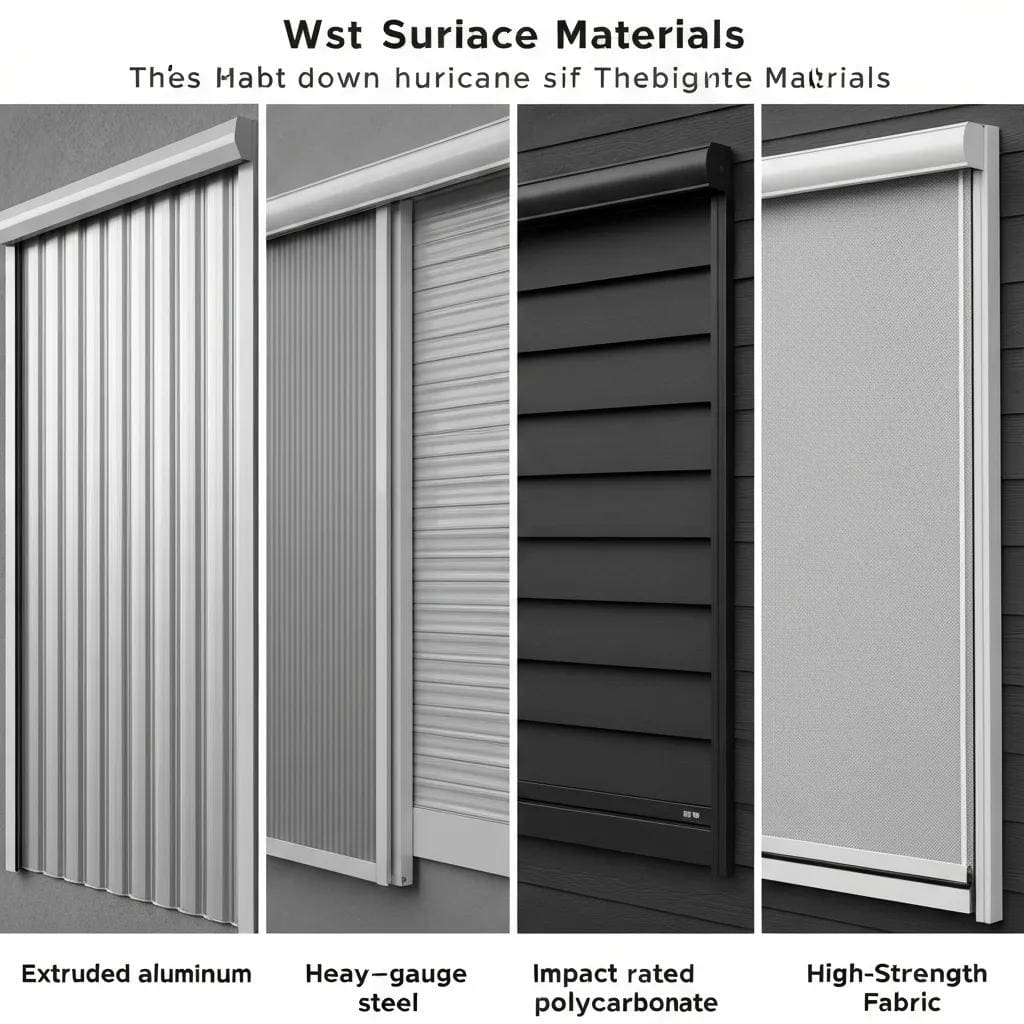
A straightforward, attribute-by-attribute comparison helps you decide which material best fits a property’s protection, appearance, and budget goals. The table below summarizes strength, weight, corrosion resistance, cost range, maintenance, UV behavior, security level, and typical code-compliance tendencies so owners can quickly compare installed costs and lifecycle implications. After the tables we interpret those rankings for coastal NC/SC conditions and typical residential situations to show which materials usually make sense for different exposures.
The following table compares core attributes across the four material types.
This concise snapshot shows the relative strengths: aluminum for corrosion performance and light weight, steel for top-tier impact resistance, polycarbonate for clarity, and fabric for minimal headbox size.
Below is a more detailed performance-focused table.
These entries clarify which materials need more active care and which provide more passive resilience. For system-level specs and installed cost guidance, see product pages and our project cost calculator for system-specific details.
How do strength, weight, and corrosion resistance differ across materials?
By raw strength the typical order is Steel > Aluminum > Polycarbonate > Fabric — reflecting steel’s density and aluminum’s favorable strength-to-weight ratio that delivers good performance with less mass. Weight affects headbox size, motor capacity, and ease of manual operation — lighter materials lower mechanical demands and can reduce installation cost. Corrosion resistance is a separate axis: aluminum and properly finished polycarbonate handle salt-air better than untreated steel, though steel can be protected with galvanizing and robust coatings. For coastal NC/SC homes, balancing strength with corrosion control often favors extruded aluminum or coated steel where extreme impact resistance is required.
How do cost, maintenance, and aesthetic options vary by material?
Installed cost depends on material, motorization, and project complexity: fabric is typically the most economical up front, followed by aluminum, polycarbonate, and heavy-gauge steel when factoring in reinforcement. Maintenance frequency mirrors vulnerability: steel needs active corrosion control, polycarbonate needs surface care to preserve clarity, and fabric requires cleaning and periodic replacement in harsh exposure. Aesthetically, aluminum accepts powder coats in many colors and profiles; polycarbonate supports clear or tinted options; and fabric offers mesh choices for shade and opacity. Consider lifecycle cost and insurance incentives, since insurers may reward durable, code-compliant systems that lower expected loss over time.
Maintenance checklist by material:
- Aluminum: Inspect finishes, remove salt deposits, lubricate guides.
- Steel: Check for rust, maintain protective coatings, monitor sacrificial elements.
- Polycarbonate: Clean with non-abrasive products and consider scratch-resistant coatings.
- Fabric: Wash fabric, inspect stitching and seals, reapply UV protection when needed.
Following these tasks reduces the chance of failure and keeps systems reliable season after season.
What factors should influence your choice of roll-down shutter material?
Selecting shutter material is a balance of budget, local climate exposure (salt spray, humidity), building-code and insurance requirements, operation preference (manual vs. motorized), and aesthetic priorities. Coastal NC/SC properties face salt-air corrosion and higher design pressures in storms, which increases the importance of corrosion resistance, certified design loads, and strong anchoring. Below we list a decision checklist and explain how professional engineering (Design Pressure Analysis) lowers specification risk so your chosen material meets both performance and compliance needs.
Key factors to prioritize when selecting material include:
- Budget vs. lifecycle cost: Weigh upfront price against expected maintenance and replacement intervals.
- Local climate and corrosion exposure: Salt-air and humidity favor more corrosion-resistant options.
- Building code and insurance requirements: Confirm required design pressures and necessary certifications.
- Operation preferences and aesthetics: Decide on motorized convenience, manual redundancy, and the look you want.
Weight these factors by your property’s risk profile, and get a professional assessment for exposed sites.
The table below summarizes typical installed cost ranges and ROI considerations by material.
This cost overview clarifies trade-offs between initial investment and potential long-term savings from reduced damage and insurance benefits. For coastal properties, materials that control corrosion and meet design pressures often deliver better lifecycle value despite higher upfront cost.
Local climate and code matters because salt spray accelerates degradation and wind loads set the design pressures your shutters must meet. Companies that perform Design Pressure Analysis and use corrosion-resistant fasteners reduce specification risk. Proper anchoring with 18-8 stainless steel fasteners and engineered attachment details ensures shutters transfer loads reliably into the structure — a key part of long-term performance.
How do budget and installation costs affect material selection?
Material cost is only part of installed price: labor, motorization, structural reinforcement, permits, and finish choices all influence the final budget. Motorized systems add motor and control costs but improve rapid deployment and usability on larger openings; heavier materials demand larger motors and stronger mounting, increasing installation complexity. For example, a 200 sq ft patio can vary significantly in installed cost depending on fabric versus polycarbonate and will also have different maintenance timelines. Planning with longevity and insurance savings in mind often favors a modestly higher initial investment for materials that reduce long-term replacement risk.
Why are local climate and building codes important when choosing materials?
Local climate — salt-air corrosion, humidity effects, and typical wind speeds — directly affects expected service life and material suitability, especially in coastal NC/SC where salt spray can erode unprotected metals. Building codes and test protocols (Florida Building Code, Miami-Dade standards) set minimum design pressures and testing requirements that provide a performance baseline. Specifying systems with appropriate design pressure calculations and certified components avoids non-compliance and potential insurance disputes. For exposed coastal properties, prioritize corrosion-resistant materials and verified engineering to match materials to environmental demands.
How does American Hurricane Shutters ensure quality in roll-down materials and installation?
At American Hurricane Shutters we focus on engineered protection and verified materials for roll-down applications, with high-grade extruded aluminum and Cleartek impact-rated polycarbonate as core offerings. Our designs aim to meet or exceed Florida Building Code benchmarks, and we install with 18-8 stainless steel fasteners to reduce corrosion-related failures. We also provide Design Pressure Analysis so each project is specified for the actual wind loads and exposure at the property. Free estimates and consultations are available for homeowners in Wilmington, NC; Myrtle Beach, SC; Oak Island, NC; Topsail, NC; New Bern, NC; and Pawleys Island, SC to review site-specific options and system specifications.
Below we summarize our material and installation differentiators and suggest next steps for homeowners seeking engineered protection.
What makes our high-grade aluminum and Cleartek polycarbonate stand out?
Our extruded aluminum delivers a high strength-to-weight ratio that enables compact headbox designs and efficient motorization, with good inherent corrosion resistance when finished correctly. Cleartek impact-rated polycarbonate panels combine optical clarity with strong impact performance so you can keep natural light and views without sacrificing protection. Both material lines are presented as engineered system components sized to meet code-driven design pressures, helping homeowners balance visibility, protection, and longevity without guesswork.
How does professional installation improve shutter performance?

Professional installation matters because correct anchoring, proper fastener selection, and precise alignment ensure the shutter system transfers wind and impact loads into the building structure — not into weak points that can fail. Using 18-8 stainless steel fasteners resists salt-air corrosion and preserves load capacity over time. Design Pressure Analysis tailors shutter sizing and reinforcement to local wind exposures. Professional motorization setup and calibration further improve deployment reliability and reduce mechanical wear. Together, engineered specification and skilled installation lower failure risk and help meet insurance and code reviewer expectations.
- Request a free estimate: Get a site-specific assessment and cost estimate tailored to your property’s exposure.
- Ask for Design Pressure Analysis: Ensure shutters are sized and anchored for actual local wind loads.
- Confirm material options: Review extruded aluminum and Cleartek polycarbonate choices for performance and appearance.
These next steps help you turn the technical comparisons in this guide into a practical, site-specific protection plan with professional support.
This guide has defined the primary materials, offered technical comparisons, and provided maintenance and cost guidance to help you choose durable, code-conscious roll-down shutters for coastal properties. Use the decision checklist, maintenance tips, and comparison tables here to prioritize materials that balance protection, cost, and longevity for your location and project.
Frequently Asked Questions
What factors should I consider when choosing roll-down hurricane shutters?
Consider budget, local climate exposure, building-code and insurance requirements, and your aesthetic and operation preferences. Coastal locations often call for corrosion-resistant materials and systems specified for higher design pressures. Also decide whether you prefer manual or motorized systems, since operation choice affects installation complexity and cost. Prioritizing these factors helps you select a durable, compliant shutter system that fits your property.
How do I maintain my roll-down hurricane shutters?
Maintenance depends on the material: for aluminum, inspect finishes and clean salt deposits; for steel, watch for rust and maintain protective coatings; for polycarbonate, use non-abrasive cleaners and protect against scratches; for fabric screens, wash fabric and check UV coatings and seals. Establishing a routine inspection and cleaning schedule will extend service life and ensure reliable performance in storms.
Can I install roll-down hurricane shutters myself?
Some homeowners tackle DIY installs, but professional installation is generally recommended. Proper installation ensures the shutters can meet design pressures and withstand impact loads. Installers perform Design Pressure Analysis, select correct materials and fasteners, and ensure proper anchoring and alignment — all of which reduce the risk of failure and help satisfy codes and insurers.
What is the expected lifespan of different shutter materials?
Lifespan varies by material and maintenance: aluminum, when maintained, often exceeds 20 years; steel can last similarly but needs more corrosion care; polycarbonate typically lasts 10–15 years depending on UV exposure and care; fabric screens often need replacement every 5–10 years in harsh exposures. Regular maintenance maximizes lifespan for all options.
Are there insurance benefits for installing hurricane shutters?
Yes — many insurers offer discounts for homes with hurricane shutters because they lower expected storm damage. Savings depend on insurer and location, so check with your provider. Professional installation and systems that meet local code can improve eligibility for discounts.
What are the cost differences between shutter materials?
Costs vary by material and system complexity. Fabric screens are usually the most economical at $20–$60 per sq ft. Aluminum typically runs $30–$80 per sq ft. Polycarbonate ranges from $50–$125 per sq ft. Heavy-gauge steel is often $40–$100 per sq ft once reinforcement and anchoring are included. Factor in maintenance and potential insurance savings for a full financial picture.
How do I know if my shutters meet local building codes?
Work with a professional installer or contractor familiar with your local regulations. They can perform a Design Pressure Analysis and confirm shutters are sized and anchored for site-specific wind loads. You can also check with your local building department for required certifications and documentation for hurricane protection systems.
Conclusion
Choosing the right materials for roll-down hurricane shutters matters for durability, compliance, and effective storm protection. Understanding the strengths and limits of aluminum, steel, polycarbonate, and fabric lets homeowners make informed choices that balance cost and performance. Prioritize local climate and building codes, and work with professionals to specify and install systems that meet your needs. Contact us today for a free estimate and expert guidance tailored to your property.