
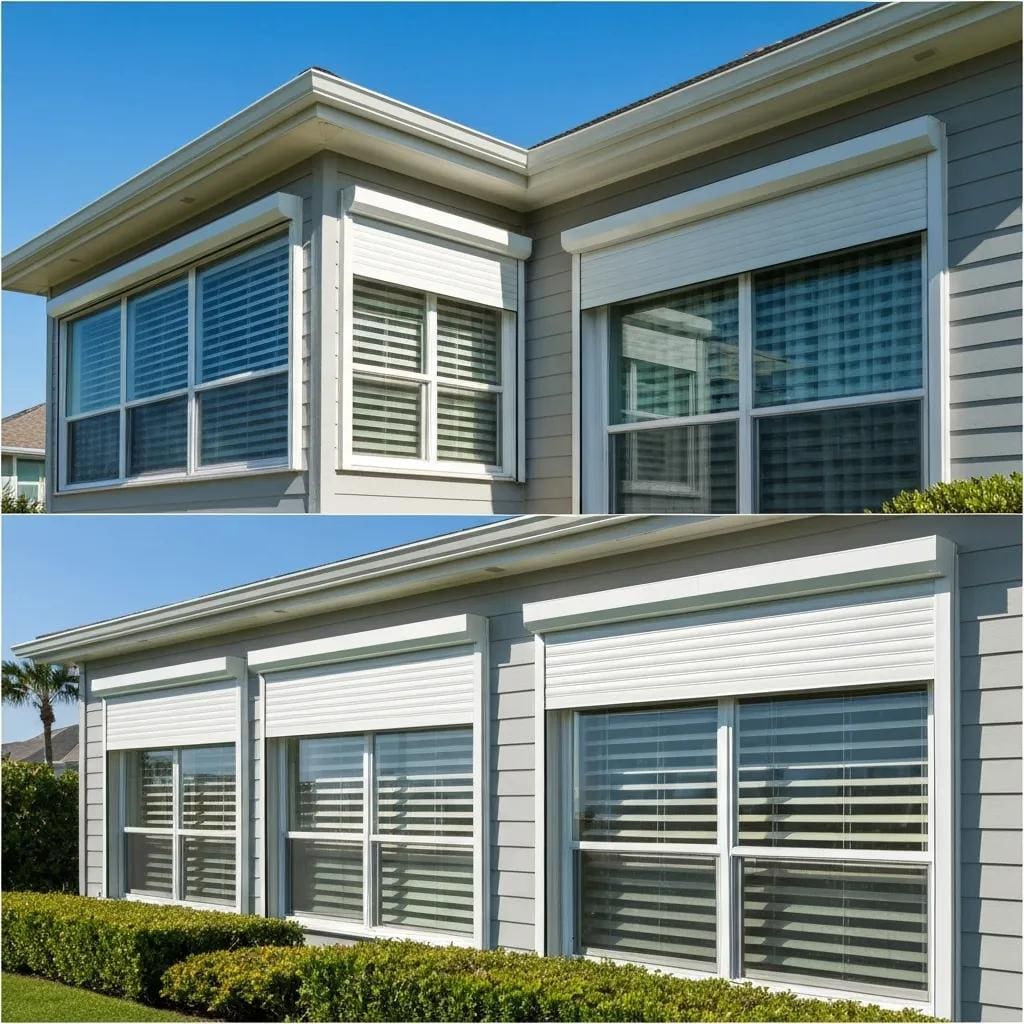
Accordion Shutters vs. Traditional Window Treatments — A Practical Guide for Coastal Homes
Accordion shutters and interior window coverings often serve different, complementary jobs. Accordion shutters are exterior, track-mounted systems built to deploy fast and protect against impact and high winds; traditional treatments like blinds, shades and curtains live inside and focus on light control, privacy and style. This guide breaks down how each solution works, how they affect interior design and curb appeal, and the trade-offs homeowners face when balancing coastal-safe protection with everyday aesthetics. We cover mechanical basics, coastal styling tips, protection and energy performance, cost and lifecycle value, plus everyday usability — including motorization and smart-home options. Facts about materials, fasteners and warranties are highlighted so you can compare practical attributes and get the right professional estimate for homes in coastal North and South Carolina.
What are accordion shutters vs. traditional window treatments?
Accordion shutters are permanently mounted, multi-panel protection systems that slide on tracks to cover openings quickly, creating an engineered barrier against windborne debris and changing pressure. Their interlocking panels stack compactly when stored and form a rigid, continuous face when closed — combining strength with fast deployment. By contrast, traditional window treatments — blinds, shades and curtains — are interior elements meant to manage light, privacy and texture; they are not designed to provide structural storm protection. Knowing this difference explains why many homeowners choose a layered approach: exterior protection for safety and interior treatments for the room’s look and feel. The next section explains the deployment mechanics and materials that make accordion shutters a durable coastal choice.
How do accordion shutters work to protect coastal homes?
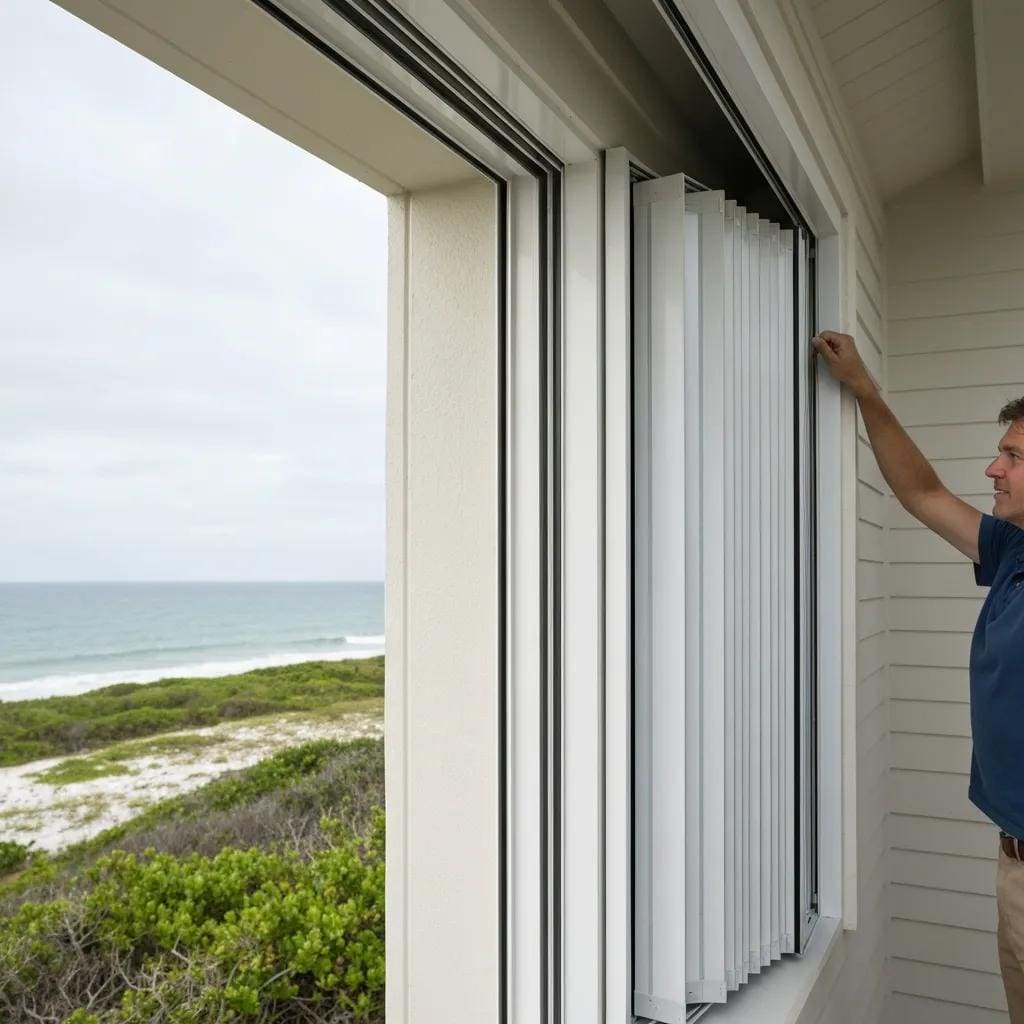
Accordion shutters run on top and bottom tracks. Aluminum panels slide together and lock to form a continuous, impact-resistant barrier that resists wind pressure. Panels are commonly made from 6063-T6 aluminum and fastened with corrosion-resistant hardware such as 18-8 stainless steel to stand up to salt-air conditions. Deployment time ranges from seconds to a few minutes per opening depending on size and experience, and locking hardware secures shutters to pre-installed anchors to resist uplift and intrusion. These mechanical details are engineered to meet applicable impact and wind-load ratings for high-wind zones; they’re the features to examine when evaluating installation quality and expected long-term performance.
Coastal Home Protection: Window and Door Systems for Storm Safety
Properly designed and installed window and door protection systems are critical for safety during severe wind storms. Many coastal homes—especially in high-risk regions—remain vulnerable to hurricane damage when openings are not adequately protected.
Coastal Homes: Critical Design and Construction Issues, TP McAllister, 2002
What are the main features of traditional window treatments like blinds and curtains?
Traditional treatments include horizontal and vertical blinds, roller and cellular shades, and a wide variety of curtains and draperies made from woven or knit textiles, natural fibers and synthetic blends. Their strengths are light control, acoustic softening and visual texture — they shape mood and scale through fabric weight, pattern and hardware. But these products are interior finishes: they don’t provide engineered impact resistance, sealed barriers or wind-load anchoring, so they aren’t storm protection. For coastal interiors, designers usually pair durable, UV-resistant fabrics with exterior protection to preserve finishes and fabric life. The next section compares how these two solution classes affect home decor and curb appeal.
When homeowners want local expertise and reliable installation, American Hurricane Shutters is a family-owned, disabled-owned company serving coastal North and South Carolina. We offer accordion shutters as a primary option along with roll-down, Bahama and Colonial styles, hurricane screens and storm panels. Our services include installation, repairs, maintenance and retrofits — backed by a 7-year warranty and full insurance coverage. We use materials such as 6063-T6 aluminum and 18-8 stainless steel fasteners to meet impact and pressure ratings. For a personalized assessment, request a free accordion shutter estimate or try our cost calculator for a no-obligation price projection. With that local support in mind, the following section compares how shutters and interior treatments shape home style.
How do accordion shutters and traditional treatments affect decor and curb appeal?
Because accordion shutters are exterior, structural elements that sit outside the glazing when closed and compress into a narrow stack when stored, they influence both interior light and the home’s street-facing look. Closed during storms they block view and light entirely and present a uniform exterior plane that can be finished in standard coastal colors to match trim and roofing. When stored, their slim profile preserves sightlines so interior treatments can define room style without obstruction. Planning both the deployed and stored aesthetics helps homeowners coordinate interior layering and curb appeal. The next sections cover color and styling choices for shutters and the decorative role of interior treatments.
What color and style options do accordion shutters offer for coastal homes?
Accordion shutters typically come in coastal-friendly finishes like White, Ivory, Bronze and Beige, letting homeowners match shutters to siding, trim and roof color for a cohesive exterior. Powder-coat and custom finish options resist fading in salt-air environments and maintain appearance through changing weather. Because shutters are visible from the street both open and closed, choosing a finish that complements architectural details protects resale value and neighborhood harmony. Picking a matching finish minimizes visual contrast when closed, while a complementary tone can create a deliberate accent that enhances character.
Three practical exterior styling approaches work well on coastal homes:
- Match the trim: Align shutter color with window trim for a seamless, integrated look.
- Contrast for accent: Use a complementary tone to highlight architectural details and boost curb appeal.
- Neutral continuity: Choose Whites or Ivories for a classic coastal palette that pairs with most siding.
These approaches let shutters support both protection and design goals while interior treatments handle room-level style.
How do traditional window treatments enhance interior design?
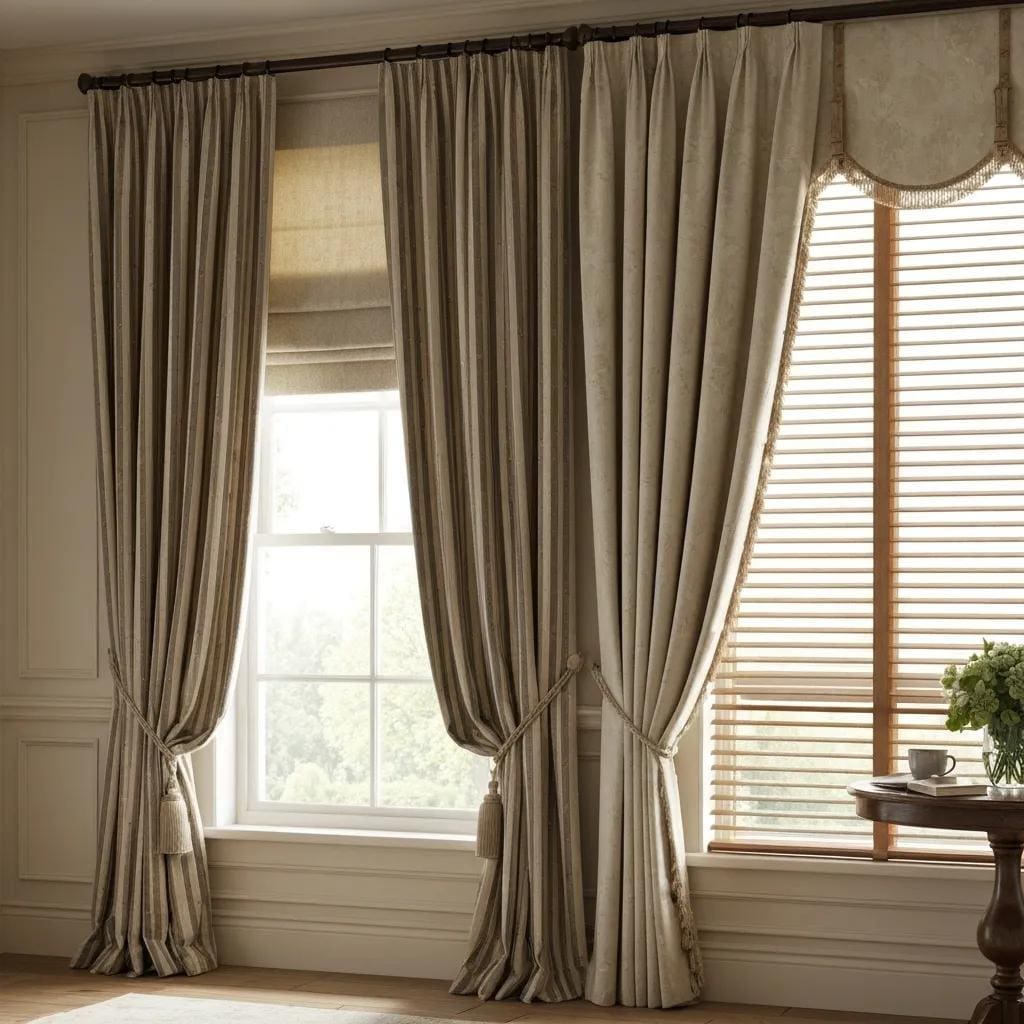
Interior treatments give designers unmatched flexibility: fabric, texture and hardware choices define mood, scale and rhythm in each room. Light fabrics and sheers soften daylight for a breezy coastal feel; heavier curtains and cellular shades add insulation and layered light control. Designers often layer sheers behind heavier drapes or pair blinds with side panels to combine diffusion and visual framing, allowing seasonal or functional shifts in ambiance. Knowing how shutters look when stored helps homeowners choose fabric weights and mounting points so drapery stacks or valances won’t be obstructed. Next we’ll compare protection and durability where the differences are most important.
Protection and durability: what’s the real difference?
Accordion shutters and interior window coverings differ fundamentally in impact resistance, wind-load performance, permanence and intrusion deterrence. Shutters are engineered to resist windborne debris and pressure changes; blinds and curtains are not. Shutters use structural panels, locking systems and robust fasteners to form a protective envelope; interior treatments offer minimal mechanical resistance and are vulnerable in severe weather. Durability depends on material choice, maintenance and service life in coastal exposure. The table below summarizes protection attributes so you can compare risk and performance.
This comparison shows accordion shutters provide a continuous physical barrier against impact and pressure, while interior treatments remain decorative and comfort-focused. Treat interior coverings as secondary features — not primary storm protection. The following sections explain how shutters protect a structure and why interior options fall short in storms.
How do accordion shutters protect against hurricanes and intrusion?
Accordion shutters protect openings through interlocking panel geometry, anchored track systems and secure locking hardware that transfers wind loads into the building structure. 6063-T6 aluminum offers a strong framework, and 18-8 stainless steel fasteners resist corrosion to keep anchorage reliable over time in coastal conditions. Certified installations that meet impact and pressure ratings lower the chance of window breakage and reduce internal pressure spikes that can lead to structural damage during storms. Regular inspections and maintenance — checking tracks, fasteners and seals — keep performance consistent over the service life. These mechanics explain why shutters are accepted as primary storm-protection elements.
Hurricane Shutter Performance Under Impact Testing
Test setups have evaluated glass and protective systems by subjecting framed openings to projectiles such as a 2×4 launched by a pendulum. Results demonstrate how properly installed protection reduces glazing failure under realistic impact conditions.
Performance of hurricane shutters under impact by roof tiles, KR Gurley, 2010
Why don’t traditional window treatments serve as storm or security protection?
Blinds and curtains consist of thin slats or fabrics mounted on interior headrails and are not built to absorb impact energy or resist uplift and lateral storm loads. In high winds, interior treatments provide no structural anchoring — fabrics can tear or be pulled away, leaving glass exposed. For security, lightweight slats or fabrics offer negligible deterrence against forced entry because they lack a continuous, lockable barrier. Combining engineered exterior protection with interior decor lets homeowners keep style without compromising safety. Next we’ll quantify energy and UV differences between these options.
Energy efficiency and UV protection: how do they compare?
Accordion shutters help control energy by creating an exterior shading layer that reduces direct solar heat gain, while blinds and curtains manage light inside the room but still allow heat transfer through the glazing. Closed shutters act as a physical thermal barrier that can lower peak indoor temperatures; interior treatments reduce interior brightness and provide some insulation but can’t stop radiant heat at the glass. For homeowners protecting furnishings and saving energy, pairing exterior shutters with interior treatments and UV-filtering glazing offers the broadest protection. The table below shows typical thermal and UV attributes.
Shutters offer the strongest reduction in direct solar load, while interior options add insulation and UV blocking as secondary benefits. Used together, they maximize comfort and protect finishes. The next subsections cover specific energy benefits and realistic expectations for blinds and curtains.
What energy benefits do accordion shutters deliver?
Accordion shutters cut solar heat gain by shading the glass and creating an exterior buffer that reduces direct radiation and convective transfer at the window. That lowers peak indoor temperatures during sunny periods and can reduce HVAC runtime on west- and south-facing exposures. Shutters also block UV rays that fade fabrics and finishes, protecting interior surfaces when closed. Exact savings vary with climate, orientation and how often shutters are used, but shutters provide consistent, durable shading that interior-only solutions can’t match. These benefits pair naturally with interior treatments for year-round comfort management.
How effective are blinds and curtains for insulation and UV protection?
Blinds and curtains vary widely in insulation and UV blocking depending on materials and construction. Cellular shades offer the best interior insulation by trapping air; heavy, lined drapes cut radiant heat and reduce UV transmission when closed. Still, interior systems can’t prevent solar energy from reaching the glazing assembly, so they’re less effective than exterior barriers. For protecting furnishings, choose high-UPF fabrics or UV-blocking liners — but remember that exterior shutters provide the most reliable protection against both heat and UV exposure. Next we’ll look at costs and lifecycle value.
Cost comparison: upfront price versus long-term value
Cost decisions should balance initial purchase and installation against lifetime value, maintenance and incidental benefits like insurance discounts and resale appeal. Accordion shutter pricing depends on the number of windows, custom sizes, site complexity, motorization and certified installation; their long-term value includes service life, storm protection and potential insurance savings. Traditional treatments usually have lower upfront costs and simpler installs but may need replacement sooner or require higher-end fabrics to reach higher performance. The table below outlines cost drivers, maintenance expectations and long-term value to guide budgeting and ROI thinking.
The table highlights shutters as an investment in protection and durability, while interior treatments are aesthetic investments with shorter replacement cycles. If you’re ready to evaluate options, the next section explains key cost factors for shutters and how to get accurate pricing.
How much do accordion shutters cost and what is their long-term value?
Price varies by opening size, configuration and whether you choose motorization. Major cost drivers are the number of openings, custom fabrication needs, hardware complexity and installation access. While exact figures depend on your site, long-term value comes from extended service life, lower storm damage risk and warranty protection that supports lifecycle cost calculations. We stress quality materials (6063-T6 aluminum, 18-8 stainless steel fasteners), full insurance coverage and a 7-year warranty to support predictable long-term performance. Get a detailed proposal, use our cost calculator, or request a free quote to compare lifecycle ROI against interior-only solutions.
What are typical costs and maintenance needs for traditional treatments?
Traditional treatments cover a wide price range based on fabric quality, hardware and custom tailoring. Maintenance usually means routine cleaning, occasional hardware repair and periodic replacement as styles or materials age. Blinds may need track or slat repairs, shades can lose spring tension, and curtains may need relining to keep UV protection effective. Overall, they have lower initial costs but potentially higher cumulative replacement and style-refresh expenses over decades. Evaluate total cost of ownership by considering replacement schedules, cleaning and the degree of protection you need alongside exterior options. Next we review everyday usability and automation.
Ease of use: shutters versus interior treatments
Accordion shutters are built for quick deployment and secure anchoring and can be operated manually or fitted with motorized drives for remote or automated control. Interior treatments are designed for frequent daily adjustments of light and privacy and also come in motorized versions. Consider deployment speed for storm readiness, track and motor maintenance, and smart-home compatibility when comparing ease of use. The next subsections describe deployment and motorization options and compare daily operation needs for interior systems.
Deployment options for accordion shutters, including motorized and smart systems
Accordion shutters can be manual — simple, reliable and low-maintenance — or motorized for remote control, scheduled closure and smart-home integration. Motorization adds convenience for multi-story homes or many openings and can be tied to weather alerts for automatic responses. Some systems allow retrofit motorization, though compatibility should be checked during planning. Choosing manual or motorized operation is a balance between simplicity and automation convenience.
- Motorized shutters add remote control and automation convenience.
- Manual shutters keep mechanics simple and maintenance minimal.
- Retrofit motor options can modernize existing systems if compatible.
How do traditional treatments compare for daily use?
Blinds, shades and curtains are built for frequent adjustment, with simple cords, wands or motorized drives that can be integrated into home automation for convenience. Motorized interior treatments improve accessibility and can be scheduled or voice-controlled, offering functionality similar to motorized shutters. Interior mechanisms — rollers, springs and cords — need occasional maintenance to keep operation smooth and safe, especially for corded products where child safety is a concern. For homeowners who want daily convenience and storm readiness, pairing motorized interior controls with exterior accordion shutters creates a unified approach to comfort, security and automation. To arrange an on-site assessment or get a free quote and estimate using our cost calculator, contact American Hurricane Shutters by phone or request an estimate through our local office.
Frequently Asked Questions
What are the maintenance requirements for accordion shutters?
Accordion shutters need periodic checks and simple upkeep to stay dependable. Inspect tracks, locking hardware and seals for wear or corrosion — especially in salt-air coastal areas — and clean panels and tracks to remove dirt and debris that can affect operation. Although materials like 6063-T6 aluminum and stainless steel fasteners are chosen for durability, routine checks catch small issues before they become problems and ensure shutters work when you need them most.
Can accordion shutters be installed on any type of window?
Yes — accordion shutters can be customized for many window shapes and sizes, including standard rectangles, arches and oversized openings. Installation details vary by window design and building architecture, so it’s important to consult a professional installer who can recommend the right solution. Custom fabrication is often available to ensure a proper fit and to preserve both protection and appearance.
How do accordion shutters affect home insurance premiums?
Installing accordion shutters can lower insurance premiums because they significantly reduce the risk of storm damage. Many insurers offer discounts for homes with certified impact-resistant protection. Check with your insurance provider to understand specific discounts and any documentation they require; keeping installation receipts and maintenance records helps when applying for savings.
Are there energy efficiency benefits to traditional window treatments?
Yes — interior treatments can improve energy performance when designed with insulating materials. Heavy drapes and cellular shades help reduce heat loss in winter and block sunlight in summer, stabilizing indoor temperature. They don’t replace the thermal barrier of exterior shutters, but they complement exterior protection to enhance overall efficiency. Consider UV-blocking fabrics to protect furnishings while improving insulation.
What is the lifespan of accordion shutters compared to traditional treatments?
Accordion shutters generally outlast interior window coverings because they’re built from durable materials and engineered for structural performance. With proper maintenance, shutters can last 20 years or more. Traditional treatments often need replacement every 5–10 years depending on material, use and fashion — making shutters a stronger long-term investment for homeowners who prioritize safety and durability.
Can accordion shutters be automated for ease of use?
Yes — many accordion systems can be motorized for remote operation and automation. Motorized shutters are especially helpful for multi-story homes or properties with many openings, enabling quick deployment when storms approach. Motorized systems can integrate with smart-home platforms so shutters can be controlled via apps or voice commands for added convenience and safety.
What are the aesthetic considerations when choosing between shutters and traditional treatments?
When choosing between accordion shutters and interior treatments, consider how each supports your overall aesthetic. Shutters are exterior features that can improve curb appeal and tie into architectural lines. Interior treatments offer more variety for fabrics, colors and styles to personalize living spaces. Many homeowners choose a layered approach — exterior shutters for protection and interior treatments for daily style — to achieve both safety and beautiful interiors.
Conclusion
Deciding between accordion shutters and traditional window treatments comes down to priorities: shutters give essential storm protection, durability and strong energy-shading benefits; interior treatments deliver daily comfort, texture and style. Most coastal homeowners get the best of both worlds by combining exterior protection with interior design layers. For tailored guidance and a free estimate, contact American Hurricane Shutters — we’ll help you find the right balance of safety and style for your home.