

How to Maintain Roll‚ÄëDown Hurricane Shutters for Reliable, Long‚ÄëLasting Protection
Roll‚Äëdown hurricane shutters are a proven way to protect windows and openings: interlocking slats run in tracks to resist wind‚Äëborne debris and water. This guide walks coastal homeowners and property managers through practical maintenance for both manual and motorized shutters‚Äîhow to clean, lubricate, inspect, and troubleshoot so your system works when you need it most. Salt air, mechanical wear, and electrical issues accelerate failure on the coast; regular service lowers that risk, extends service life, and helps satisfy building‚Äëcode and insurance requirements. Below you’ll find sensible maintenance schedules, step‚Äëby‚Äëstep cleaning and lubrication instructions, troubleshooting flows for common mechanical and motor faults, clear rules for DIY versus pro work, and a seasonal pre/post‚Äëstorm checklist. We use industry terms‚Äîtracks, slats, motor, crank, housing, control system‚Äîand explain why engineered materials like 18‚Äë8 stainless steel matter. Follow these steps to improve reliability and know when to call a qualified technician.
Why Regular Maintenance Matters for Roll‚ÄëDown Shutters
Regular upkeep keeps roll‚Äëdown shutters ready by preventing corrosion, removing debris, and confirming mechanical and electrical systems function so shutters deploy and lock correctly in a storm. Routine maintenance catches wear on slats, tracks, rollers, and motors before small problems turn into failures. For coastal homeowners, that means longer service life, lower lifetime costs, safer occupants, and better documentation for insurance or code inspections. Below are the main benefits of maintenance and the risks of skipping it.
Maintenance delivers these core benefits:
- Stops salt‚Äëair corrosion and material breakdown that can seize tracks and fasteners.
- Finds and fixes misalignment or wear before shutters fail to deploy.
- Preserves motor and control reliability through regular testing and electrical checks.
Those advantages lead directly into how individual actions—cleaning, lubrication, inspection—translate into safer, longer‑lasting shutters in coastal conditions.
How Maintenance Extends Shutter Life and Improves Safety
Maintenance breaks the chain: salt and debris → mechanical wear → misalignment and motor strain → deployment failure. Cleaning removes grit and salt crystals that abrade slat edges and tracks; lubrication lowers friction on rollers and bearings so motors or cranks work with less torque. Inspections uncover loose or corroded fasteners, damaged seals, or worn end caps before they become larger problems. Using corrosion‑resistant replacements—like 18‑8 stainless steel fasteners—stops recurring failures and reduces downtime, keeping shutters able to meet impact and wind‑load expectations.
Next: a recommended service cadence for coastal homes and how exposure level changes the schedule.
How Often Should Coastal Homeowners Service Their Shutters?
Coastal exposure speeds corrosion and grit ingress, so plan more frequent checks. A practical rule: operate shutters monthly, perform homeowner cleaning and visual checks quarterly, and schedule a professional inspection annually. Properties with higher exposure—closer to open water or salt sources—should consider professional service twice a year for motor diagnostics, Design Pressure Analysis checks, and replacement of corroded fasteners with corrosion‑resistant hardware. Keep a simple log of operations and inspections to spot accelerating wear and to support insurance claims if needed.
With that schedule in place, the next section shows safe cleaning methods that remove salt and debris without harming finishes.
Best Cleaning Techniques for Roll‚ÄëDown Hurricane Shutters

Cleaning preserves paint and seals and prevents particles from lodging in tracks and housings, keeping operation smooth. The goal is to remove abrasive salt and organic debris that accelerate wear and corrosion. Use gentle tools and mild detergents‚Äîavoid harsh chemicals and high‚Äëpressure washers‚Äîand prioritize ladder and fall safety when working at height. Below are stepwise cleaning actions and quick do/don’t tips to protect materials and seals.
Follow these steps to clean slats and tracks safely:
- Inspect and photograph the shutter exterior and housing before cleaning to note loose fasteners or damaged slats.
- Lower the shutter partway and use a soft brush to loosen debris from slat faces and track entrances.
- Rinse gently with fresh water, wipe with mild soap on a microfiber cloth, and avoid pressure washers that can drive water into housings.
After cleaning, keep these safety and preservation practices in mind:
- Do: Use mild soap, soft brushes, and freshwater rinses to remove salt without stripping protective coatings.
- Do: Wear gloves and use a stable ladder or platform when accessing housings.
- Don’t: Use pressure washers, acetone, or abrasive pads that can damage paint, seals, or finishes.
Next we cover the specific products and tools that work best for coastal shutter systems.
How to Clean Slats and Tracks Safely
Start with an inspection and follow a methodical sequence so you don’t push debris deeper into housings or damage finishes. Run one full open/close cycle to loosen particles, then secure the shutter partially closed to access tracks. Remove large debris by hand or with a soft brush, vacuum the track where possible, and use a mild soap solution on a microfiber cloth to clean slat faces‚Äîwipe along the slat seams. Rinse with fresh water, let parts air‚Äëdry, then cycle the shutter after drying to confirm smooth travel and note any binding or unusual noises for follow‚Äëup.
This stepwise approach helps you pick cleaning products and tools compatible with coastal conditions.
Recommended Cleaning Products and Tools
Choose cleaners that remove contaminants without attacking paint, seals, or lubricants. Mild dish soap and fresh water are ideal for routine cleaning. Use soft‑bristle brushes, microfiber cloths, and a low‑suction vacuum for tracks; avoid steel wool, strong solvents, and pressure washers that can harm housings or coatings. For stubborn salt buildup, a diluted vinegar spot treatment rinsed thoroughly can help—use sparingly. Keep a small parts kit with 18‑8 stainless fasteners, neoprene seals, and spare remote batteries to handle minor repairs found during cleaning.
With cleaning done, next is how to lubricate moving parts to preserve smooth operation.
How to Lubricate Shutter Tracks for Smooth Operation
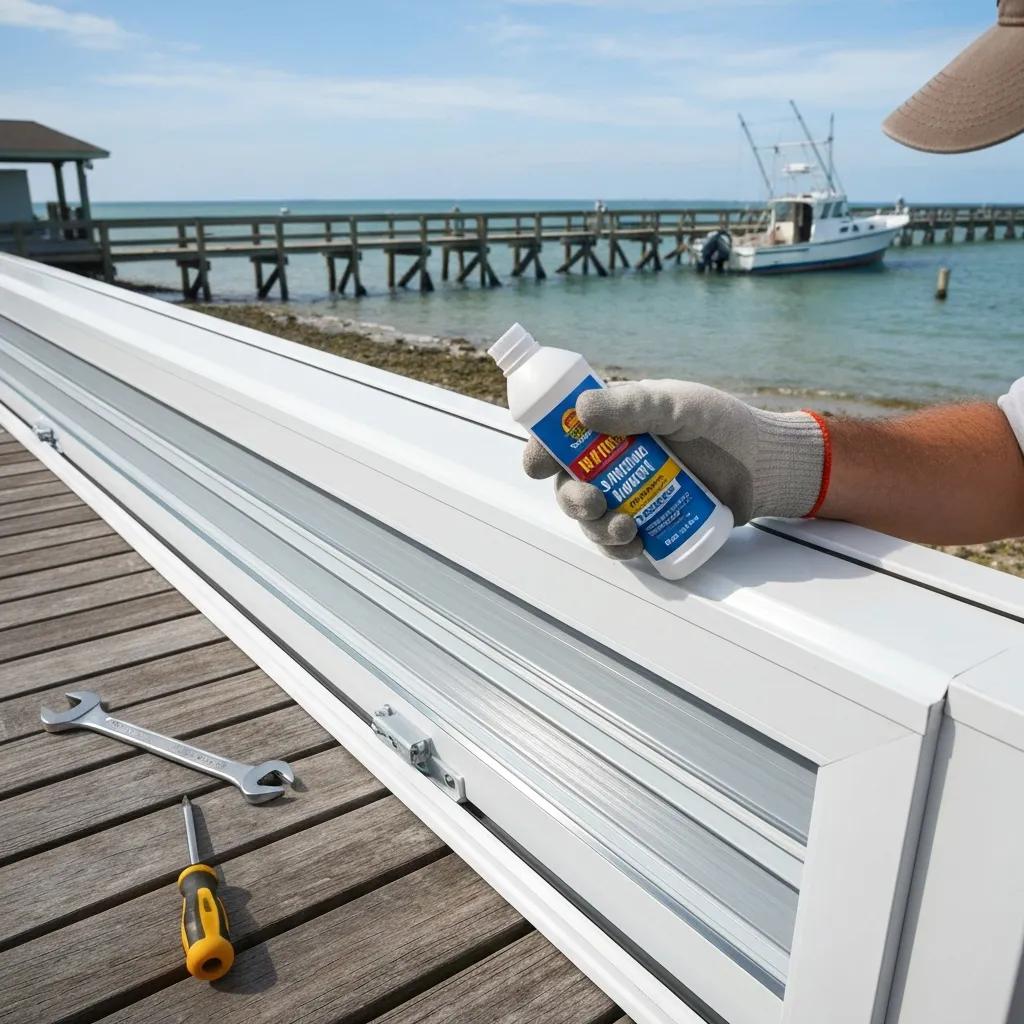
Lubrication lowers friction on tracks, rollers, bearings, and pivots—especially important where salt spray and micro‑corrosion raise resistance. Use lubricants that repel salt and don’t attract dust, and apply them sparingly so residue doesn’t trap grit. Below we list where to apply lubricant, which types work best in coastal settings, and how often to reapply based on exposure.
Key lubrication points and timing include:
- Apply lubricant to tracks, rollers, bearings, and pivot pins after cleaning and full drying.
- Reapply a thin dry‚Äëfilm silicone or equivalent every six months for moderate exposure; check quarterly in high‚Äëexposure coastal sites.
- Avoid heavy oil‚Äëbased lubricants that attract dust and hold salt crystals.
Dry silicone creates a water‚Äëresistant, low‚Äëfriction film that limits particle adhesion and protects metal from salt spray.
This table helps match lubricant type to the component and supports sensible reapplication timing described next.
Best Lubricants for Coastal Conditions
On the coast, dry silicone and PTFE‚Äëbased dry lubricants are preferred because they leave low‚Äëresidue films that resist salt and don’t attract dust. Graphite spray is useful on locks and sliding contacts where wet grease would capture grit. Wax‚Äëbased options can be used sparingly on slat interfaces but will need more frequent touch‚Äëups. Avoid wet oils and heavy greases on exposed tracks‚Äîthey trap abrasive particles and can turn lubrication into an abrasive. Inside motors, follow the motor manufacturer’s grease recommendations and use heavier greases only in sealed gearboxes.
Proper Method and Frequency for Lubrication
Always clean and dry before lubricating. Apply targeted, minimal amounts, then cycle the shutter several times to distribute the lubricant. For moderate exposure, lubricate tracks and rollers every six months; for high‚Äësalt exposure, inspect quarterly and lubricate as needed. Wipe away excess to prevent buildup and log each lubrication event to track product performance and wear trends.
With lubrication handled, the following section covers common troubleshooting for mechanical and motor issues.
How to Troubleshoot Common Problems with Roll‚ÄëDown Shutters
Troubleshooting is a stepwise process: observe symptoms, isolate likely causes, and run safe checks that either fix the problem or point to professional help. Common issues include sticking or jamming, uneven travel, motor failure, and corrosion‚Äërelated hardware problems. Use the problem ‚Üí cause ‚Üí solution framework below, and always follow safety precautions before inspecting motorized systems.
Before you begin diagnostics: disconnect power to motorized systems before opening housings and wear PPE when working near sharp slat edges. The table below summarizes common failures, signs, and homeowner checks.
What Causes Sticking or Jamming — and How to Fix It
Sticking often comes from debris, salt crystals packed into seams, bent slats catching guides, or misaligned tracks. Visually inspect tracks and run a partial cycle to locate the bind. Clear debris with a soft brush or vacuum, then apply dry silicone to the affected area. If a slat is bent, avoid forceful straightening—minor, safe adjustments are fine for homeowners, but significant bends require professional straightening or replacement to avoid worsening the fit. After cleaning or adjustments, cycle slowly to confirm smooth travel and log the work.
Knowing how to manage mechanical jams helps you spot when the issue is electrical or motor related and needs different checks.
How to Diagnose Motor and Electrical Problems
Start with basic power checks, controls, and visible wiring. Confirm the breaker and power source, replace remote or wall switch batteries, and listen for motor hums. Try manual override to separate mechanical from electrical faults. If the motor is hot, smells burnt, or wiring looks damaged, stop and document symptoms for a technician—do not continue to operate the unit. Routine professional inspections handle internal motor checks and Design Pressure Analysis verification; anything beyond simple power or battery fixes should be left to certified technicians to protect safety and warranty.
Those troubleshooting steps lead into clear rules for DIY versus professional intervention.
When to DIY and When to Call a Professional
Choose safety first. Homeowners can handle cleaning, lubrication, battery replacement, tightening visible fasteners, and simple track clearing. Anything that involves motor replacement, electrical wiring, structural anchors, bent or broken slat replacement, or significant corrosion remediation should be performed by trained technicians to maintain safety, code compliance, and warranties. Use the short checklist below to decide whether to attempt a DIY fix or call a pro.
Use this checklist to decide action:
- Surface debris, sticky tracks, remote battery replacement, or loose visible fasteners ‚Üí safe DIY steps.
- Motor overheating, burning smell, major slat deformation, or compromised anchor points ‚Üí stop and call a professional.
- Motorized faults involving internal gears, wiring, or gearbox seals ‚Üí schedule professional inspection and repair.
Professional services include advanced testing, engineered inspections, and written estimates for insurance—details follow.
Minor Repairs Homeowners Can Safely Do
Tasks that don’t require opening motor housings or changing structural connections are appropriate: clearing tracks, sanding small burrs, tightening accessible hardware with hand tools, replacing remote batteries, and making minor alignment adjustments within manufacturer limits. Always isolate power on motorized systems before working near housings and use safe ladder practices. Stick to non‚Äëstructural replacement parts‚Äîneoprene seals or 18‚Äë8 stainless screws‚Äîand avoid improvised materials that accelerate corrosion or void warranties. After any repair, run multiple cycles to verify function and log the activity.
These safe DIY steps save time and money while protecting system integrity; for heavier work, call a professional.
Issues That Require Professional Service
Call a technician for motor replacement, internal electrical diagnostics, major corrosion remediation, slat replacement, anchor or structural repairs, or any work affecting Design Pressure Analysis compliance. Professionals have the tools, engineered parts, and 18‚Äë8 stainless hardware to perform code‚Äëcompliant anchorage and load verification. They also provide documentation and free estimates that help with insurance claims. For high‚Äëexposure coastal properties, scheduled professional maintenance reduces emergency repairs and helps ensure shutters meet performance expectations.
If you call a pro, choose a provider that emphasizes engineered protection and transparent estimates.
Seasonal Maintenance Checklist for Roll‚ÄëDown Shutters
A seasonal checklist organizes pre‚Äëstorm readiness and post‚Äëstorm recovery into a repeatable calendar that protects the system and occupants. Pre‚Äëstorm tasks focus on operation tests, cleaning, lubrication, and securing fasteners; post‚Äëstorm work centers on damage assessment, debris removal, corrosion checks, and documentation for repairs or insurance. The table below lists actionable tasks, recommended frequency, and tools or notes for safe completion.
Remember: operate shutters monthly and tighten inspections 48–72 hours before a forecasted storm.
Use this calendar as your regular routine; next are the priority checks to do 48–72 hours before a hurricane.
Pre‚ÄëStorm Inspections to Perform
Within 48–72 hours of a predicted storm, prioritize an operation test, track and housing cleaning, lubrication of moving parts, inspection of fasteners and anchors, and verification of backup power for motorized systems. Run each shutter through a full open/close cycle twice to check for hesitations or unusual noises. Tighten visible hardware, replace remote batteries if needed, and confirm housings and seals are secure to reduce water intrusion. Log findings and photograph any anomalies to speed up professional help if required.
Completing pre‚Äëstorm checks sets you up for a focused post‚Äëstorm assessment if damage occurs.
Post‚ÄëStorm Maintenance Steps
After a storm, perform a methodical damage check: photograph exteriors, inspect tracks and slats for dents or deformation, remove lodged debris, and look for accelerated corrosion or compromised anchors. Clean salt and organic debris promptly to slow corrosion, and document all damage with date‑stamped photos and a short report for insurance. If you spot major structural damage, motor failure, bent slats, or anchor compromise, limit further operation and schedule a professional inspection with a written estimate—this preserves safety and ensures repairs meet engineered standards. Remember the goal: educate homeowners, generate leads with free estimates, and support existing customers with clear service.
American Hurricane Shutters specializes in installation, maintenance, and repair of roll‚Äëdown shutters across coastal North and South Carolina. We offer professional inspections, Design Pressure Analysis, and maintenance using corrosion‚Äëresistant hardware like 18‚Äë8 stainless steel. If professional service is needed after your assessment, choose a provider that documents findings and provides a transparent free estimate or use our cost calculator to plan repairs and budget.
- If roll‑down shutters aren’t the right fit, consider alternatives: accordion shutters, Bahama shutters, hurricane fabric panels, or impact windows for broader protection.
- For motorized systems, prioritize providers who perform engineered inspections and verify compliance with applicable building‚Äëcode performance standards.
These options and selection tips finish the practical guidance for keeping coastal properties protected long term.
Frequently Asked Questions
What are the signs that my roll‚Äëdown hurricane shutters need maintenance?
Look for difficulty opening or closing, unusual noises, visible corrosion on tracks or slats, and debris in the tracks. Misalignment or sticking during operation are also clear signs. Regular inspections catch these early so shutters stay ready when you need them.
How can I ensure my roll‚Äëdown hurricane shutters are ready for a storm?
Do a full pre‑storm inspection 48–72 hours before the storm: test each shutter, clean tracks and housings, lubricate moving parts, and check fasteners and anchors. Verify remote controls and backup power. Document findings and address issues immediately to ensure reliable performance.
What should I do if my motorized shutters are not responding?
First check power: breakers, wiring at the source, and remote or wall switch batteries. If power is present and the motor won’t run, listen for hums or other sounds. If the motor is hot, smells burnt, or wiring looks damaged, stop operating and call a professional—internal motor repairs should not be attempted by homeowners.
Are there specific tools I need for maintaining my shutters?
Yes. Keep a soft brush or microfiber cloth for cleaning, a low‑suction vacuum for track debris, and dry silicone or PTFE spray for lubrication. Basic hand tools—screwdrivers, pliers—and safety gear like gloves and a stable ladder are also useful.
How can I document maintenance for insurance purposes?
Keep a maintenance log with dates for inspections, cleaning, lubrication, and repairs. Take timestamped photos before and after work, especially when you note issues. Clear documentation helps when filing insurance claims and shows you’ve taken reasonable care.
What are the risks of neglecting shutter maintenance?
Neglect can lead to mechanical failure during a storm, reduced protection for your home, costly repairs, and possible non‚Äëcompliance with building codes that affects insurance coverage. Regular upkeep is the best way to protect your investment and your safety.
Conclusion
Routine maintenance keeps roll‑down hurricane shutters reliable and extends their service life—protecting your home when storms hit. Follow the cleaning, lubrication, inspection, and troubleshooting steps above, and schedule professional service when issues are beyond safe DIY scope. Ready for help? Schedule your next maintenance check or request a consultation—we’re here to make sure your shutters perform when it matters most.
