

Real Results From Accordion Shutters: The Complete Guide to Coastal Protection and Benefits
Accordion shutters are a trusted hurricane-protection system that form a rigid, impact-resistant barrier over doors and windows. This guide shows how they work, why they’re especially effective for coastal homes in North Carolina and South Carolina, and how local success stories prove their performance in real storms. You’ll get a clear look at the key design features—interlocking blades, top and bottom tracks, and sturdy locking hardware—that deliver strength and fast deployment when a storm is on the way. We map each benefit to measurable outcomes, compare accordion shutters with other options, and cover cost, insurance savings, and maintenance strategies for salt-air conditions. Near the end, we explain how American Hurricane Shutters offers free consultations, a cost calculator tool, and engineered installations using 18-8 stainless steel fasteners backed by a local-leading 7-year warranty so homeowners can get realistic estimates and documentation. After this overview, the guide dives into protection advantages, regional case studies, mechanical and security benefits, cost and ROI, professional installation, and coastal maintenance recommendations.
Why Accordion Shutters Are the Smart Choice for Coastal Hurricane Protection
Accordion shutters balance fast deployment, proven structural strength, and a low visual profile—qualities that make them a preferred option for coastal hurricane protection. Their interlocking blades slide along top and bottom tracks to create a continuous barrier that resists wind pressure and blocks flying debris. Outside of storm season, they also serve as year-round security and privacy solutions for coastal homes. Below, we break down the specific benefits, the mechanisms that deliver them, and how material and installation choices preserve performance in corrosive environments.
Accordion shutters deliver five core advantages that address coastal homeowner priorities and storm performance.
Those benefits translate to measurable outcomes: single-person deployment cuts exposure time, continuous coverage reduces breach risk, heavy-duty locks improve forced-entry resistance, extruded aluminum holds shape under high loads, and properly chosen fasteners preserve anchorage in salt air.
Here’s a concise mapping of benefits to mechanisms and real-world outcomes for the Carolina coast.
This mapping shows how design choices create practical protection—and leads into the discussion on materials and durability that follow.
What Key Benefits Do Accordion Shutters Bring to Coastal Homes?
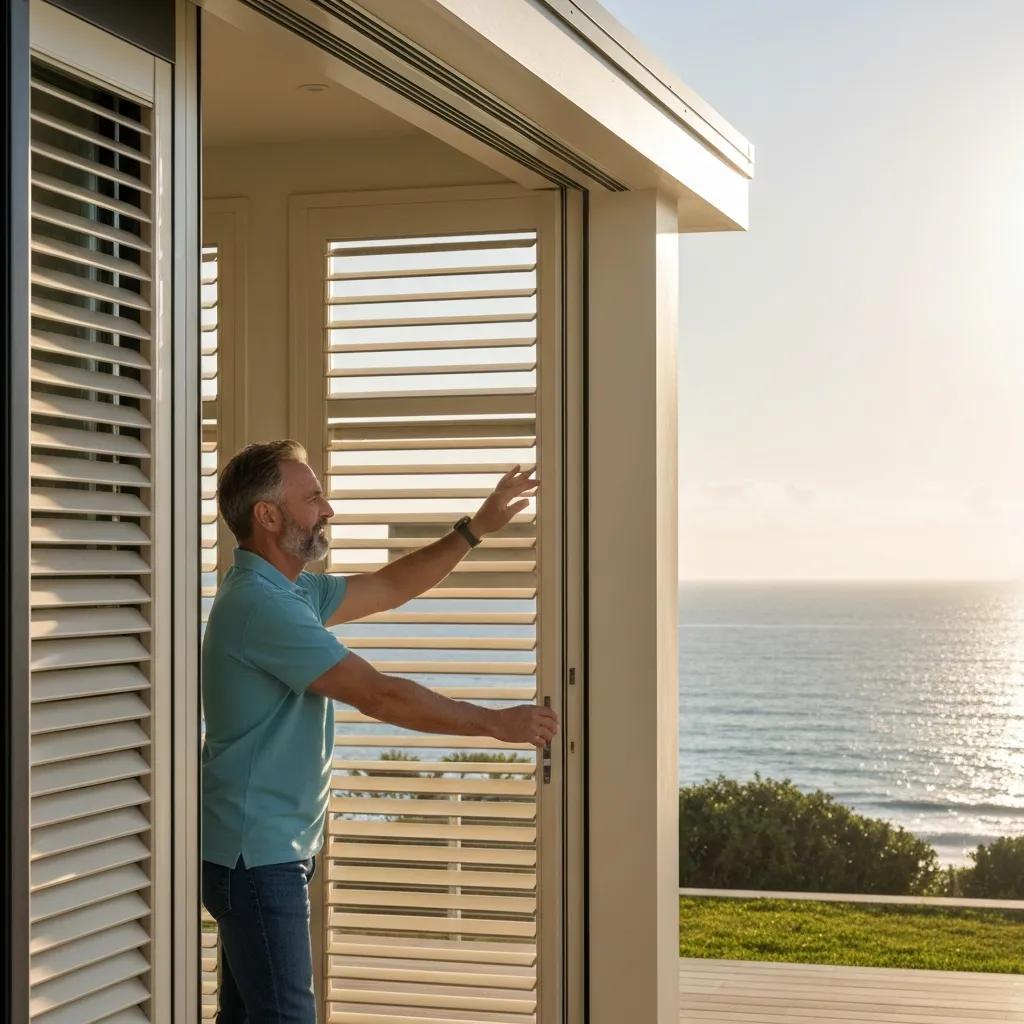
Accordion shutters combine engineered components to offer protection, speed, and everyday usefulness. Interlocking blades form a continuous barrier that resists wind pressure and deflects debris, lowering the chance of glass failure and subsequent water intrusion. Panels slide into place on tracks, so one person can secure multiple openings quickly—critical when evacuation windows are short. That simplicity, paired with year-round security and privacy, makes accordion shutters a practical, multi-use investment for coastal homeowners preparing for hurricane season.
These strengths support coastal living by reducing structural damage and enabling faster readiness when a storm approaches. Next, we examine the materials and installation details that enable this durability.
How Accordion Shutters Deliver Durability and Storm Resistance
Durability starts with good materials and sound connections: extruded aluminum blades resist bending under high wind loads, and 18-8 stainless steel fasteners reduce galvanic corrosion in salty air so anchorage stays strong over time. A top-and-bottom track system spreads wind loads across many attachment points, and secure locking hardware prevents uplift and forced entry during storms. Warranties and certified installations further protect your investment by ensuring components and workmanship meet performance expectations. Those construction details explain why properly specified accordion shutters outperform ad-hoc or poorly installed panels in coastal storms.
These material and installation choices naturally introduce local examples of performance, which we review next to show homeowner experiences and outcomes.
Real-Life Success Stories: Accordion Shutters in Action
Local case studies and homeowner reports offer concrete proof that accordion shutters reduce storm damage and protect interiors during Carolina storms. When shutters are correctly specified and installed, they often limit glass breakage and stop water intrusion that would otherwise cause expensive interior repairs. The sections that follow highlight examples from Wilmington and Myrtle Beach and then summarize common testimonial themes that point to performance, peace of mind, and installer professionalism. These stories show how design and installation come together to provide measurable protection.
Below are specific examples of how accordion shutters performed in significant local storms, with outcomes like minimized property damage and faster post-storm recovery. These vignettes also emphasize that performance depends on correct sizing, anchorage, and maintenance.
How Wilmington and Myrtle Beach Homeowners Benefited From Accordion Shutters
Homeowners in Wilmington and Myrtle Beach report that accordion shutters prevented glazing failures and limited interior water damage during recent storms, allowing faster recovery and fewer insurance claims. In each case, shutters were in place before peak winds, forming a rigid barrier that deflected windborne debris and let residents shelter safely or leave with confidence. Many property owners say the biggest savings came from avoiding major interior repairs—drywall, flooring, and electrical work—rather than the shutter cost itself. These local stories show how timely deployment and correct installation lead to measurable protection for coastal properties.
These case studies feed into broader testimonial patterns that reveal consistent homeowner priorities and satisfaction after storms.
What Customer Testimonials Say About Accordion Shutter Performance
Across testimonials three themes stand out: reliability under stress, professional installers, and the value of warranties and documentation for insurance. Homeowners often highlight easy deployment and the reduced anxiety of storm prep, noting that certified installation and stainless steel fasteners boost long-term confidence. Short customer quotes typically focus on practical results—less damage, easier cleanup, and clear communication from installers—underscoring the peace-of-mind benefits beyond technical performance. These recurring points help buyers decide which products and installers to trust for coastal protection.
With those homeowner perspectives in mind, the next section explains how accordion shutters work at the component level.
How Accordion Shutters Work: Features, Design, and Security Benefits
Accordion shutters work by combining interlocking blades, tracks, and locking hardware into a continuous barrier that turns wind and impact forces into distributed loads across the frame. That reduces point loads on glass and frames, improving resistance to debris strikes and fluctuating pressures. Systems range from manual units for smaller openings to motorized drives for large doors and storefronts—the trade-offs are automation, deployment time, and cost. The subsections that follow break down key components and explain how the system also boosts year‑round home security beyond hurricane protection.
Independent research has measured the ability of accordion shutters to reduce wind-driven rain intrusion, showing they can meaningfully lower water entry during storm conditions.
Accordion Shutter Effectiveness in Reducing Wind-Driven Rain Intrusion
The presence of these shutters and impact resistance mechanisms. To assess the effectiveness of shutters in reducing wind-driven rain intrusion, a series of tests were conducted. In terms of the measured pressure differential across the window assembly, the accordion shutter showed a significant reduction in water ingress. The reduction in wind-driven rain intrusion for the accordion shutter ranged between 6-14% for the wind conditions tested.
Wind driven rain intrusion reduction for shuttered windows, KS Vutukuru, 2019
This component table shows how each part adds to storm resistance and long-term durability, setting up a closer look at design elements and materials next.
Key Design Elements and Materials of Accordion Shutters
Important design features include interlocking blades sized for local wind loads, reinforced rails that spread lateral forces, and high-strength locking hardware to prevent uplift and intrusion. Materials strike a balance between strength and corrosion resistance: extruded aluminum panels resist deformation while remaining easy to handle, and 18-8 stainless steel fasteners and locks prevent rust-related failures in coastal climates. Protective coatings add UV and salt-spray resistance to preserve appearance and performance over time. These choices result in a durable system that continues to protect as exposure accumulates.
These design and material details naturally lead into how shutters improve home security and daily utility, which we cover next.
How Accordion Shutters Improve Year‚ÄëRound Home Security
Accordion shutters provide continuous physical coverage that deters opportunistic break-ins and offers privacy control when storms aren’t a concern. Integrated locks add a physical barrier that complicates forced entry, and full coverage across large openings removes easy access points. Unlike temporary panels, a permanently mounted accordion system is always ready—reducing the chance a home is vulnerable while its owners are away or off-season. That year-round utility strengthens the overall value of accordion shutters beyond hurricane preparedness.
Testing has quantified reductions in wind-driven rain intrusion when shutters are used, reinforcing their role in protecting homes from severe weather.
Testing Accordion Shutters for Wind-Driven Rain Intrusion
Holistic testing to determine quantitative wind-driven rain intrusion for shuttered and impact resistant windows. This study focusses on rain intrusion quantification into a window configuration, with and without accordion shutter. An impact-resistant window was also tested.
Holistic testing to determine quantitative wind-driven rain intrusion for shuttered and impact resistant windows, KS Vutukuru, 2020
This reinforces how parts relate to long-term coastal performance and leads into the cost and ROI discussion.
How Much Do Accordion Shutters Cost—and What Long-Term Value Do They Deliver?
Price depends on opening size, customization, optional motorization, and installation complexity, but the investment often offsets repair costs over time and can qualify homeowners for insurance discounts that improve ROI. Key cost drivers include the number and size of openings, reinforcement needs for very large spans, and whether you choose motorization for convenience. Durable materials and corrosion-resistant fasteners also lower the chance of mid-life component replacement. The paragraphs below outline pricing factors and provide typical cost ranges to help homeowners estimate investment and savings.
For practical budgeting, use the cost calculator and request a free estimate so you get a tailored price that reflects your openings and local code needs; those tools give the most accurate projection for insurance documentation and ROI. The table below compares common shutter types to help with decision‚Äëmaking.
Which Factors Drive Accordion Shutter Pricing and Return on Investment?
Price and ROI are driven by opening size and count, need for reinforced framing, motorized versus manual operation, finish and color choices, and access issues that affect labor time. Larger continuous openings add complexity because of reinforcement and precise track alignment; motorization adds equipment and electrical work but reduces deployment time for big openings. Local permit requirements and code compliance can add upfront cost but are essential to qualify for insurance discounts and to ensure inspected performance. Understanding these variables helps homeowners model realistic ROI scenarios with free estimates or the cost calculator.
Those pricing drivers also feed into insurance and resale discussions, which we cover next when showing how shutters can pay off over time.
How Accordion Shutters Can Lower Insurance Costs and Boost Property Value
Accordion shutters can lower insurance premiums because they reduce the risk of wind and water damage; insurers often offer discounts or credits when shutters meet recognized codes and testing standards. Proper documentation—product test reports, installation certificates, and warranty paperwork—helps demonstrate reduced risk to insurers and appraisers, potentially improving resale value by showing fortified openings and a documented mitigation strategy. Modest insurance savings combined with avoided storm-repair costs can shorten the payback period for your shutter investment. We recommend getting free estimates and using the cost calculator to quantify local savings and collect the documentation insurers will want.
Research on coastal hazard mitigation shows retrofits can deliver meaningful cost savings by reducing claims and improving home resilience.
Cost-Benefit Analysis of Retrofitting Homes for Coastal Hazard Mitigation
Housing vulnerability is a large contributor towards high claims costs for Suncorp, and the subsequent premium affordability issues for consumers. Reducing this vulnerability will decrease the risk associated with severe wind events, which can then be reflected in pricing for consumers.In 2014, Suncorp commissioned the Cyclone Testing Station (CTS) at James Cook University to conduct a comprehensive study to enhance Suncorp’s understanding of the vulnerability of houses in North Queensland to natural hazards, particularly tropical cyclones and thunderstorms. The study involved the analysis of insurance claims for residential homes in North Queensland (NQ) after Cyclone Yasi. Key drivers of cyclone-induced losses were identified in the Phase I analysis. As a recent extension of that work, the current study (Phase II) builds on the Phase 1 by estimating the reduction in losses based on retrofit and mitigation solutions for the typical loss drivers.
Cost-benefit of Retrofitting and Community Engagement with Mitigation [Report for Suncorp Group Limited], D Smith, 2015
Why Professional Installation Matters for Accordion Shutters

Proper installation matters because correct anchorage, precise alignment, and corrosion-resistant fasteners determine performance in high winds. Incorrect fastening or track misalignment creates weak points that can let wind pressures breach openings, negating the benefits of quality materials. Certified installers follow industry protocols, provide documentation to support warranties and insurance claims, and help ensure the system performs as designed. The sections that follow explain the practical advantages professional teams bring and how compliance is verified in practice.
Hiring pros also reduces safety risks and speeds the job: crews bring the right anchors and tools to attach shutters to structural framing rather than non-structural surfaces. Professional work preserves manufacturer warranties and supplies the paperwork insurers and building officials often require. The next subsection highlights typical installation strengths from a regional provider that combines engineered hardware, certified technicians, and clear warranty terms.
Benefits of Expert Installation by American Hurricane Shutters
American Hurricane Shutters (AHS Carolinas) delivers installation practices that support long-term performance: certified and insured technicians with coastal experience install systems using 18-8 stainless steel fasteners and offer a local-leading 7-year warranty on workmanship and materials. Their process includes free consultations and estimates, and the cost calculator helps homeowners get tailored pricing and the documentation insurers expect. Certified installation ensures track alignment, anchorage to structural framing, and adherence to performance specs that reduce failure risk in severe storms. Choosing an experienced local installer helps protect both your system and your ability to use warranty and insurance benefits.
How Accordion Shutters Meet Local Building Codes in NC and SC
Accordion shutters are manufactured to meet recognized testing standards and—when installed correctly—can meet or exceed the benchmarks used in building codes. Installers should provide test reports, product approvals, and installation certificates to confirm compliance. While Florida’s building code is a common standard for windborne debris and design pressures, homeowners in North Carolina and South Carolina should request documentation tied to local permit requirements and confirm the system meets regional wind-speed and attachment standards. Installers typically prepare permit-ready documentation and coordinate inspections when required, so requesting these documents up front avoids surprises and supports future claims or resale disclosures.
Confirming code compliance also prepares homeowners to maintain their shutters effectively, which is the next section on coastal maintenance best practices.
How to Maintain Accordion Shutters for Long Life in Coastal Conditions
Maintenance in coastal areas focuses on rinsing salt deposits, lubricating moving parts, and checking fasteners to prevent corrosion-related failures that would reduce storm performance. Regular maintenance keeps tracks clear, locks working smoothly, and fasteners secure. Follow a simple seasonal checklist—quarterly visual checks and an annual tune-up with lubrication and a professional inspection—to catch minor issues before they become performance-limiting problems. The steps below show a practical cleaning routine and explain how maintenance preserves warranty eligibility and operational life.
- Quarterly: Rinse panels and tracks with fresh water to remove salt spray buildup.
- Semi-annual: Inspect visible fasteners and locks for corrosion or looseness.
- Annual: Lubricate tracks and locking mechanisms with a compatible lubricant and schedule a professional inspection if alignment or operation has changed.
Keep a maintenance log with dates and actions—this record demonstrates ongoing care and helps preserve lifespan and warranty standing.
Best Practices for Cleaning and Caring for Accordion Shutters
Start with regular rinsing of panels and tracks using fresh water to remove salt deposits that speed corrosion. Use mild detergent for stubborn grime and rinse thoroughly. Avoid abrasive cleaners or tools that can damage protective coatings—use soft brushes or cloths and manufacturer‑recommended products. Lubricate moving parts annually
