

Top Questions About Ensuring Your Existing Window Frames Work with Hurricane Shutters
Many homeowners worry whether hurricane shutters will properly fit older, historic, vinyl, or aluminum window frames. This guide breaks down what “compatibility” really means for storm protection—how the frame material and condition, plus the chosen mounting method, determine which shutter systems will perform safely, meet code, and keep retrofit costs reasonable. You’ll learn how common frame materials react under load, which shutter families pair best with each type of frame, step-by-step measurement and installation best practices, and realistic cost and permitting expectations for coastal North and South Carolina. We also cover maintenance to extend service life and compare shutters to impact windows for retrofit decisions. Throughout, practical checklists, comparison tables, and decision tips make it easier to assess risks and next steps—and we highlight where a professional assessment or a free estimate from AHS can help simplify planning.
What Window Frame Types Are Common and How Do They Affect Hurricane Shutter Compatibility?
“Compatibility” means a shutter system can be anchored, sealed, and operated on your existing frame or surrounding structure without compromising performance or the opening’s integrity. Frame material, frame condition, and how the window is set into the wall determine anchor choices, needed reinforcement, and whether the retrofit will require through-wall fasteners, header support, or a reversible mount. Knowing these variables reduces the risk of anchor failure during storms and tells you whether a non-invasive solution or structural reinforcement is required. The sections below describe common materials and the installation implications for each so you can evaluate retrofit options accurately.
Which Materials Are Used in Existing Window Frames: Wood, Vinyl, Aluminum, and Historic?
Wood frames are traditional and can be structurally strong if they’re sound, but rot, insect damage, and seasonal movement are concerns; installers often inspect for decay and add blocking or through-bolts into studs when needed. Vinyl frames are lightweight and energy-efficient but usually don’t offer reliable anchor points, so installers typically secure shutters to surrounding framing or use through-wall attachments. Aluminum frames resist rust but can be thin or flexible, so anchoring usually relies on backing into the wall or expansion anchors into masonry. Historic frames vary widely and demand preservation-minded solutions—reversible mounts or temporary panels are often preferred to avoid harming original finishes or joinery. Identifying frame material and condition is the first step before selecting hardware; next we’ll look at how those materials influence installation methods.
How Does Frame Material Influence Hurricane Shutter Installation and Fit?

Frame material shapes anchor choice, reinforcement strategy, and sealing approach: wood accepts mechanical fasteners into studs or jambs but may need rot repair; vinyl often forces installers to bypass the frame and fasten into structural members; aluminum typically requires brackets that spread loads to the surrounding substrate. Common risks from poor attachment include fastener pullout, failed seals, and wind loads transferring to the glass instead of to structure—so installers often add backing plates, sill cleats, or through-bolts. Installers will also check flashing and water-management details to avoid creating leaks when adding shutters, and may recommend weatherstripping or secondary seals. Evaluating these trade-offs helps homeowners choose shutter systems that fit their frames without compromising durability or the building envelope.
Common frame inspection checklist before retrofitting:
- Check for rot or corrosion: Look at jambs and sills for decay or rust that could weaken anchors.
- Confirm substrate behind the frame: Verify there’s solid blocking or masonry to accept structural fasteners.
- Document dimensional irregularities: Note warped sills, uneven jambs, or out-of-square openings that require a custom fit.
- Assess historic finishes: Identify surfaces or details that call for reversible or non‑invasive mounting.
- Review existing flashing and seals: Make sure shutters won’t interfere with water management.
These inspection steps prepare you to pick the right shutter system and to know when professional reinforcement is needed.
This table helps prioritize which frames are straightforward to retrofit and which need extra prep before shutter installation. The next section matches shutter types to those frame characteristics.
Which Types of Hurricane Shutters Are Best Suited for Existing Window Frames?
Picking the right shutter depends on how you’ll use it, the look you want, and—critically—where and how it mounts to the frame or wall. Some options, like storm panels and hurricane screens, are minimally invasive and suit fragile or historic frames. Permanent systems—accordion and roll-down shutters—offer fast deployment and strong protection but need solid attachment points. The subsections below compare shutter families and their compatibility considerations so you can match shutter type to frame material and preservation priorities.
How Do Accordion and Roll-down Shutters Fit Different Window Frame Materials?
Accordion shutters usually attach to jambs or the adjacent wall and fold beside the opening; they work well with wood and masonry where jambs are solid, though vinyl often requires wall-mounted brackets or added backing to carry loads. Roll-down shutters run in vertical tracks attached above and beside the opening; the header must be solid and sometimes reinforced with a support beam or backing plate—making them ideal for masonry or stud-backed walls but needing reinforcement on thin aluminum frames. Both systems transfer wind loads into the structure, not the glass, so installers check for blocking, header strength, and track clearance. If backing is inadequate, reinforcement or a different shutter type may be recommended for reliable performance.
When accordion or roll-down systems are a good fit:
- Solid jambs or masonry backing are present: Anchors can transfer loads safely into structure.
- Quick deployment is important: These systems are user-friendly and fast to operate.
- You want motorization: Both options commonly support motorized operation.
Choosing between folding and roll‑down depends on backing availability and how you intend to use the system, which leads us to less invasive options for delicate frames.
Are Colonial, Bahama, Storm Panels, and Hurricane Screens Compatible With Older or Historic Frames?
Colonial and Bahama shutters can be decorative or functional. When used as permanent storm shutters they need secure anchors at the jamb or wall—Bahama shutters often top-mount and may be less invasive if the trim accepts brackets, while colonial shutters hinge to jambs and need solid backing. Storm panels and temporary panels are the least invasive and bolt to pre-installed anchors or surrounding wall—often preferred in historic settings because they’re removable and don’t alter original joinery. Hurricane screens are a low-visibility, modern option that attach to frames or surrounding framing and can suit vinyl or delicate historic wood when installed with engineered brackets. Preservation-minded projects typically favor reversible systems or non‑permanent attachments to protect original finishes.
This compatibility matrix outlines trade-offs between appearance, installation complexity, and invasiveness. Next, we explain measurement and installation steps to make these choices work for your windows.
After comparing shutter types and frame matches, many homeowners opt for a professional frame assessment to confirm substrate and anchorage options. American Hurricane Shutters (AHS) offers frame assessment and measurement services, plus free estimates and a cost calculator to help you evaluate retrofit feasibility before ordering custom-fit systems. A professional evaluation turns compatibility info into an actionable installation plan.
How Is the Installation Process Adapted to Ensure Compatibility With Existing Window Frames?
Adapting installation starts with a thorough pre‑install inspection to document frame material, substrate backing, flashing, and irregularities—this tells the installer whether anchors can fasten to the jamb or if through-wall or wall-mounted brackets are required. Measuring for retrofit work means recording rough openings, frame width/height/depth, and noting obstructions like trim, sills, or fixtures; installers use these details to specify custom-fit shutters or to recommend reinforcement. Correct installation transfers wind loads into structural elements rather than glass or weak frame areas, achieved with backing plates, longer fasteners into studs or masonry anchors, and proper weatherproof sealing. Whether you pick professional installation or DIY depends on frame condition, code needs, and warranty rules; the next sections give concrete measuring tips and a decision framework for pro vs. DIY installation.
What Are the Best Practices for Measuring Existing Windows for Hurricane Shutters?
Accurate measuring begins by choosing the measurement plane: use outside‑to‑outside rough opening for panels, or measure the finished opening for recessed mounts. Record width, height, and depth to the nearest 1/16″ (or millimeter for metric jobs) for custom fabrication. Note obstructions like trim, gutters, or awnings and check for out‑of‑square conditions by measuring top, middle, and bottom—record any differences. Photograph and sketch unusual profiles to accompany measurements. For track systems, verify clearance for tracks and headroom for roll‑down housings or accordion pockets; for hinged systems, confirm jamb thickness and hardware clearance. When unsure, request professional measurement to ensure factory-fit shutters—accurate measurements reduce fabrication errors and installation delays.
Measurement checklist for retrofit orders:
- Measure outside‑to‑outside rough opening: Use this as the baseline for panel sizing.
- Record depth and reveal: Include frame thickness and trim depth.
- Check for out‑of‑square conditions: Measure at three heights and note variances.
- Photograph and sketch: Show mounting surfaces, obstructions, and finish details.
- Confirm headroom: Verify space above the opening for housings or tracks.
Following these practices lowers the chance of misfits and helps decide whether reinforcement is needed before installation.
Should Homeowners Choose Professional Installation or DIY for Existing Frames?
Professional installation is usually the safer option for retrofit projects that involve compromised frames, masonry mounting, motorized systems, or when local building code and warranty documentation matter—professionals ensure correct anchors, load transfer, and waterproofing, and can provide compliance paperwork. DIY may be reasonable for simple removable panel systems or temporary storm panels on sound frames, but homeowners should be realistic about their skill level and structural knowledge before attempting permanent installs. Warranty and insurance considerations often favor professional installation, and certified installers better navigate permitting and engineered attachments. If you want to balance cost and risk, consider a hybrid approach: professional measurement and reinforcement, then homeowner installation of removable panels.
Pros and cons summary:
- Professional installation: ensures code compliance, warranty support, and structural safety.
- DIY installation: lowers labor cost but carries higher risk for permanent or motorized systems.
- Hybrid approach: professional prep with homeowner-installed temporary protection.
Your best choice depends on frame condition, shutter complexity, and local permit expectations, which we cover next in the cost and code section.
This cost-and-code table gives ballpark comparisons; actual pricing depends on size, frame condition, and motorization. Use AHS’s cost calculator or request a free estimate for accurate retrofit pricing and permit-ready documentation.
What Are the Cost, Benefits, and Building Code Requirements for Retrofitting Hurricane Shutters on Existing Windows?
Retrofitting shutters offers storm protection, potential insurance savings, and possible resale value gains, but costs vary widely by shutter type, window size, frame condition, and whether structural reinforcement is needed. Cost increases when frames require reinforcement, openings are oversized or irregular, or historic-preservation constraints demand custom, non-invasive hardware. Typical cost drivers include custom fabrication, motorization for roll-downs, and repairs to rotted or thin frames prior to installation. From a regulatory perspective, permit requirements for structural attachments differ by jurisdiction—even within coastal NC and SC—and products with recognized approvals make permitting easier. When planning a retrofit, budget for inspection, possible reinforcement, and installation. The subsections below outline cost ranges and high-level permitting guidance, plus a quick-reference table for common projects.
How Much Does It Cost to Install Hurricane Shutters on Existing Window Frames?
Costs range from economical removable panels for small windows to several thousand dollars for custom, motorized roll-down systems. Simple panels are typically the lowest-cost retrofit; full-house automated roll-down systems sit at the higher end. Costs rise when frames need structural reinforcement, openings are irregular, or historic preservation requires custom mounting hardware. Additional line items can include professional measurement, permit fees, and structural framing repairs. Use the cost calculator or request a free onsite estimate from AHS to get an accurate quote reflecting frame condition and local complexity.
Typical cost drivers:
- Shutter type and materials: Solid aluminum or motorized systems cost more than temporary panels.
- Window size and shape: Larger or custom-shaped openings require more material and labor.
- Frame and substrate condition: Reinforcement or repair increases overall cost.
- Certifications and documentation: Certified products may cost more but ease permitting and insurance benefits.
A tailored quote is the best way to understand precise costs for your retrofit scenario.
What Local Building Codes and Permits Affect Hurricane Shutter Installation in Coastal NC and SC?
Permitting and code compliance vary by county and municipality; anchors that change structural attachment or add permanent hardware commonly trigger permit requirements, and coastal jurisdictions often have stricter standards because of higher wind loads. While Florida Building Code and Miami‑Dade approvals are common performance benchmarks, local building departments in North Carolina and South Carolina will set acceptable testing or product documentation and may require installation details with permit applications. Installers usually prepare product certifications and anchorage methods to support permit approval. Check with your local building department or work with an installer familiar with coastal NC/SC rules to ensure your retrofit meets applicable regulations.
Knowing what triggers a permit helps avoid delays and ensures the retrofit will pass inspection. AHS emphasizes compliance and offers free estimates and a cost calculator to help homeowners in coastal North and South Carolina understand retrofit costs and permit documentation.
How Can Homeowners Maintain and Extend the Lifespan of Hurricane Shutters on Existing Window Frames?
Routine maintenance extends shutter and frame life, preserves performance, and can protect warranty coverage. Tasks vary by shutter type but generally include cleaning tracks, lubricating moving parts, tightening and inspecting fasteners and seals, and checking motor function where applicable. Frame-specific care—repainting or resealing wood, treating corrosion on aluminum fasteners in salt air, or checking vinyl seals—prevents anchor degradation and water intrusion. Spotting wear early lets you repair before a failure during a storm. The sections below give a maintenance schedule and explain the durability factors that affect expected lifespans.
What Are the Recommended Maintenance Practices for Different Shutter Types on Various Frame Materials?
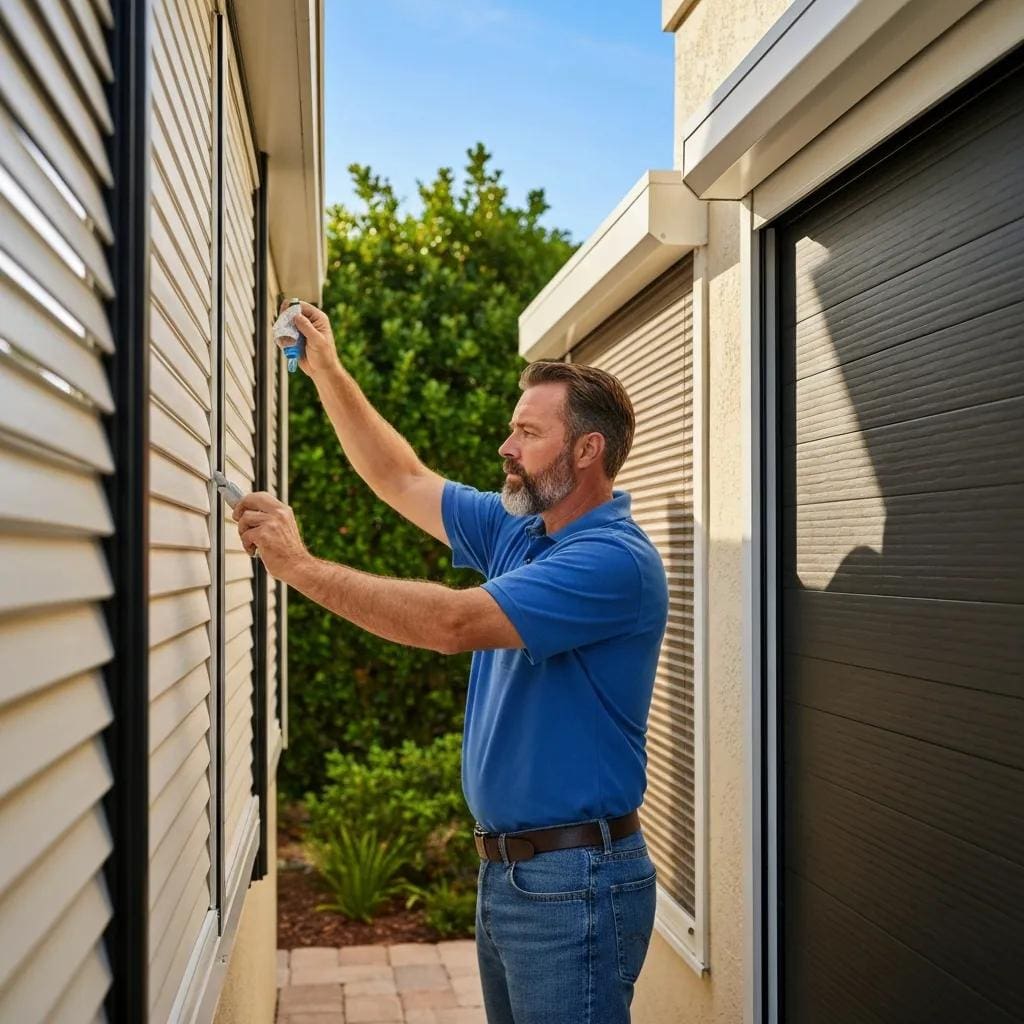
Accordion and roll-down systems need periodic track cleaning, lubrication of moving parts, and inspection of mounting brackets and fasteners to ensure nothing has loosened; motorized systems also need electrical checks and occasional professional servicing. Panels and screens should be removed and cleaned seasonally, with anchor plates inspected for corrosion or loosening, and temporary panels stored dry to prevent warping. Frame-specific maintenance includes spot-treating wood with sealant or paint to prevent rot, applying corrosion inhibitors to metal fasteners in salt-air environments, and checking vinyl seals for brittleness. Regular intervals—monthly visual checks, annual cleaning and hardware tightening, and a professional review every few years—help keep systems ready and protect original frames.
Seasonal maintenance checklist:
- Monthly visual check: Look for loose fasteners, damaged seals, or track obstructions.
- Annual cleaning and lubrication: Clean tracks and lubricate moving parts for smooth operation.
- Post-storm inspection: Check anchors and frames after major storms for hidden damage.
- Every 2–3 years professional review: Have a certified installer inspect motorized components and structural anchors.
Following these tasks reduces emergency repairs and keeps your shutter system performing when it matters most.
How Durable Are Retrofit Hurricane Shutters and What Factors Affect Their Longevity?
Longevity depends on material quality, installation integrity, environmental exposure, and maintenance. High‑grade aluminum systems installed into solid backing and maintained properly can last decades, while temporary panels or poorly anchored systems will show wear sooner. Salt air speeds corrosion on metal parts and fasteners, UV exposure degrades seals and vinyl, and mechanical abuse or frequent misoperation shortens life. Professional installation that transfers loads correctly to structural elements reduces stress on frames and glass. Regular maintenance and timely replacement of worn parts are key to extending service life.
Knowing these durability drivers helps homeowners plan upgrades and maintenance to preserve protection over time. With maintenance covered, many homeowners still have final questions about universal compatibility and how shutters stack up against impact windows.
Frequently Asked Questions
What are the signs that my window frames may need reinforcement before installing hurricane shutters?
Visible rot, corrosion, warped or out‑of‑square frames, loose fasteners, or gaps between the frame and wall are all signs reinforcement may be needed. If you see any of these issues, schedule a professional assessment—repair or added backing is often recommended before installing permanent shutters.
How can I determine if my existing window frames are suitable for hurricane shutters?
Start by inspecting the frame for damage and checking for solid backing behind it. Measure dimensions and note irregularities, then consult a professional installer if you’re unsure. An installer can confirm compatibility and recommend any required reinforcements for a safe, code‑compliant installation.
What is the typical lifespan of hurricane shutters, and how can I maximize their durability?
Shutter lifespan varies by material and care—10 to 30 years is common. Maximize durability with regular maintenance: clean tracks, lubricate moving parts, inspect seals and fasteners, and address wear promptly. Choosing corrosion‑resistant components and following seasonal checklists will extend service life.
Are there any specific building codes I should be aware of when installing hurricane shutters?
Yes. Codes and permit requirements vary locally and are often stricter in coastal areas. Permanent structural attachments and motorized systems commonly trigger permits. Check with your local building department or work with an installer experienced in coastal NC/SC codes to ensure compliance and smooth permitting.
What are the advantages of using temporary storm panels versus permanent hurricane shutters?
Temporary panels are flexible and lower cost up front, and they avoid permanent changes to the window frame—but they require labor every storm season. Permanent shutters are quicker to deploy and more convenient for frequent use, though they usually cost more initially. Your choice depends on budget, aesthetics, and how often you need protection.
How do I choose between different types of hurricane shutters for my home?
Consider your frame material, desired appearance, budget, and operational needs. Accordion and roll-down shutters offer convenience and strong protection but need solid backing. Storm panels are economical and removable. Talk with a professional installer to match shutter type to your frames and priorities.
Can Hurricane Shutters Be Installed on Any Existing Window Frame?
Generally, yes—most existing frames can accept hurricane shutters—but the final answer depends on frame condition, substrate backing, and local code. A structurally sound jamb or surrounding wall is necessary to handle shutter loads. If frames are weak, rotted, or lack backing, installers can add blocking, backing plates, or through‑wall anchors, or recommend less-invasive options like temporary panels or screens. Historic frames may need reversible mounting strategies to protect original fabric. The prudent next step is a professional assessment to identify anchorage options and confirm whether a simple retrofit or additional reinforcement is needed.
How Do Hurricane Shutters Compare to Impact Windows for Protecting Existing Frames?
Shutters are often a lower-cost, less disruptive retrofit compared with replacing windows with impact-rated glass—shutters can be installed without full window replacement and suit historic or irregular openings. Impact windows provide permanent glazing-level protection and reduce long-term shutter maintenance, but they come with a higher upfront cost and may require frame replacement if the existing frames aren’t suitable. From an insurance and resale standpoint, both approaches are valid: shutters offer flexibility and reversible protection, while impact windows offer continuous, integrated protection. Choose shutters when retrofit economy, preservation, or reversibility matter; choose impact windows if you want permanent glazing replacement and are prepared for the higher cost.
Quick decision guide:
- Choose shutters for a reversible, cost-effective retrofit with minimal window disruption.
- Choose impact windows for permanent glazing replacement when you’re ready for a larger investment.
- Consider a hybrid approach: shutters plus targeted window upgrades for key openings.
American Hurricane Shutters (AHS) offers free onsite assessments and customized quotes to help homeowners decide between shutters and other options. A professional estimate clarifies costs, code requirements, and recommended attachment methods.
This article covered frame materials, shutter matches, measuring and installation best practices, cost and permit considerations for coastal NC and SC, maintenance guidance, and common homeowner questions to help you plan a retrofit that protects your home and preserves your frames. If you’d like a professional frame assessment and an accurate retrofit quote, American Hurricane Shutters (AHS) provides expert measurements, custom-fit solutions, and free estimates with permit-ready documentation.
Conclusion
Making sure your existing window frames are compatible with hurricane shutters protects your home and preserves its look. By understanding frame materials and installation needs, you can make informed choices that protect your investment and meet local codes. For a smooth retrofit, consider scheduling a professional assessment with American Hurricane Shutters (AHS) to explore tailored solutions. Start protecting your home today—request a free estimate from AHS.